
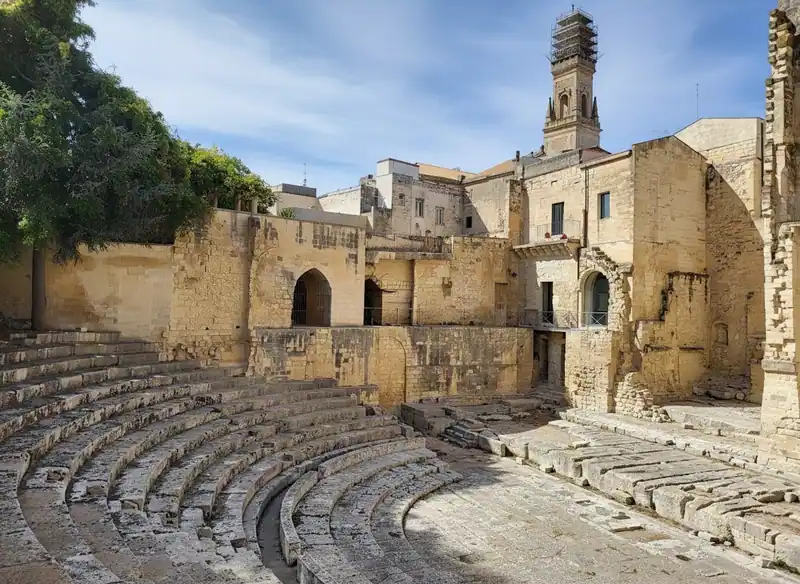
Beneath the honey-coloured baroque facades of Lecce lies a world of ancient drama—literally. The Museo del Teatro Romano occupies a graceful palazzo just steps from Piazza Sant'Oronzo, where the remains of a 2,000-year-old Roman amphitheatre still peek through the modern paving stones. This small but powerful museum stitches together the fragments of Lecce's classical past, revealing how the city once thrived as a centre of Roman culture and entertainment.
Where the Stage Once Stood
The museum's ground floor opens onto the excavated remains of the ancient theatre itself, a sunken arena ringed by worn stone seats and column stumps. The original structure could hold thousands of spectators, who gathered here to watch comedies, tragedies, and political spectacles under the Mediterranean sun. Standing at the edge of the excavation, you can almost hear the echo of applause bouncing off the limestone tiers.
Interpretive panels guide you through the theatre's architecture—cavea, orchestra, scaena—and explain how Roman engineers carved the space directly into the hillside. It's a lesson in stagecraft and civic pride, frozen in stone.
Artefacts of Performance and Daily Life
Upstairs, glass cases hold a collection of terracotta masks, ceramic oil lamps, and marble reliefs unearthed from the site and nearby excavations. These objects speak to the rituals and rhythms of life in Roman Lecce: the masks that actors wore, the coins spectators dropped, the jewelry citizens flaunted in the front rows. Look closely at the fragments of frescoes and you'll spot dolphins, theatrical motifs, and glimpses of the vivid colour that once covered every wall.
- Theatrical masks in painted terracotta, showing comic and tragic expressions
- Marble statue fragments that once adorned the theatre's stage backdrop
- Mosaics and decorative stonework salvaged from surrounding Roman houses
- Coins and everyday tools that reveal the commercial buzz around the venue
Lecce's Layered Identity
What makes this museum so compelling is the way it forces Lecce's many historical layers into dialogue. The baroque churches you passed on your way here were built with stones recycled from Roman monuments. The piazza outside was paved over the theatre's upper tiers. Even the museum building itself is a palimpsest, its Renaissance bones framing ancient rubble.
Visiting the Museo del Teatro Romano is especially rewarding if you've already wandered the nearby Basilica di Santa Croce or strolled down Via Palmieri. The contrast between ornate Lecce baroque and austere Roman engineering sharpens your sense of how this city has always been a crossroads—Greek, Roman, Byzantine, Norman, Spanish—each culture leaving its mark in stone.
Practical Rhythms
The museum is compact; you can absorb everything in under an hour, making it a natural pause during a morning exploring Lecce's centro storico. Because it's tucked just off the main tourist circuit, you'll often have the space nearly to yourself, especially mid-afternoon. Combine your visit with a coffee in Piazza Sant'Oronzo, where you can look out over the amphitheatre ruins in the open air, or wander toward the Duomo and the labyrinth of alleyways that unfurl to the south.
No tickets, no queues—just a quiet chance to connect the dots between the Lecce you see today and the one that played to packed houses two millennia ago.