
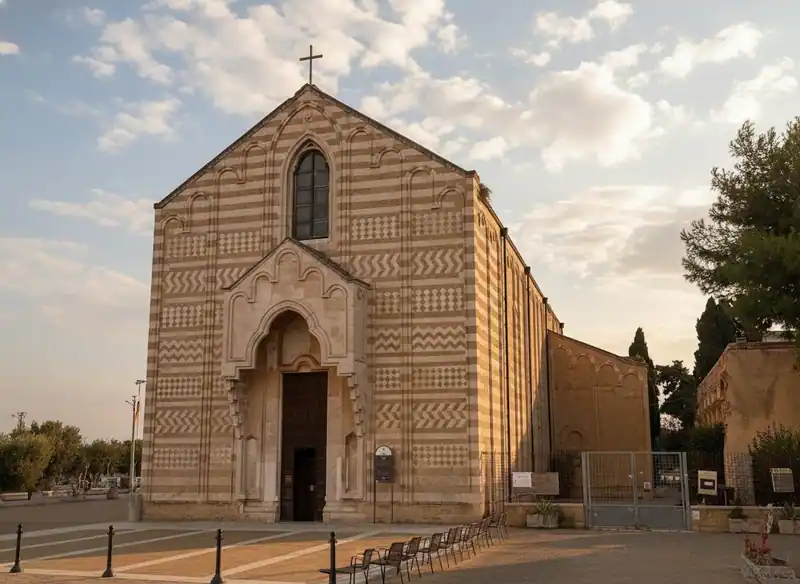
On the edge of Brindisi, where the city's ancient port heritage meets quiet countryside, stands one of Puglia's most captivating medieval treasures. The Chiesa rettoria Santa Maria al Casale rises from the Contrada Baroncino landscape like a page from an illuminated manuscript, its honey-colored stone facade covered in mesmerizing geometric patterns that have witnessed seven centuries of Mediterranean light.
A Facade That Tells Stories in Stone
The church's exterior is a lesson in opus sectile artistry, where craftsmen arranged local limestone and dark tuff into checkerboard patterns, zigzags, and interlocking diamonds. These aren't mere decorations they're visual prayers carved by 13th-century hands. The play of shadow across these patterns changes throughout the day, transforming the facade from a flat surface into a living, breathing artwork.
Look closely at the arched portal and you'll spot delicate carvings that blend Norman, Byzantine, and Arab influences a testament to Brindisi's role as a crossroads between East and West during the Crusades.
Inside the Chamber of Color and Silence
Push open the heavy wooden door and you enter a space where time moves differently. The interior opens into a single nave with exposed wooden trusses overhead, but it's the walls that command your attention. Ancient frescoes bloom across the plaster, their pigments still vibrant after centuries scenes of the Last Judgment, saints in Byzantine robes, and Christ Pantocrator gazing down with almond-shaped eyes.
The most remarkable cycle runs along the north wall, depicting the apocalyptic visions of John in vivid blues, ochres, and earth reds. Even visitors who don't consider themselves religious find themselves moved by the quiet intensity of these medieval narratives.
What to Look For
- The apse frescoes a rare 14th-century Madonna and Child in the Byzantine style, with gold leaf still catching the light
- The wooden ceiling beams, original to the 1300s, showing medieval carpentry techniques
- Stone holy water fonts carved with enigmatic symbols at the entrance
- The way afternoon light filters through the small rose window, illuminating dust motes like floating gold
- Graffiti scratched by pilgrims centuries ago tiny crosses and initials along the lower walls
Timing Your Visit and What Lies Beyond
Late afternoon brings the most magical light the setting sun strikes the western facade at an angle that makes the geometric patterns almost glow. The church sits about three kilometers north of Brindisi's historic center, making it an ideal stop before or after exploring the city's Roman columns and harbor monuments.
Combine your visit with a walk through Brindisi's medieval quarter, where narrow vicoli lead to hidden courtyards, or head to the waterfront to watch fishing boats return as they've done since ancient times. The church's quiet countryside setting offers a contemplative counterpoint to the bustling port energy of downtown Brindisi, and the contrast between the two captures the full spectrum of this historic city's character.