
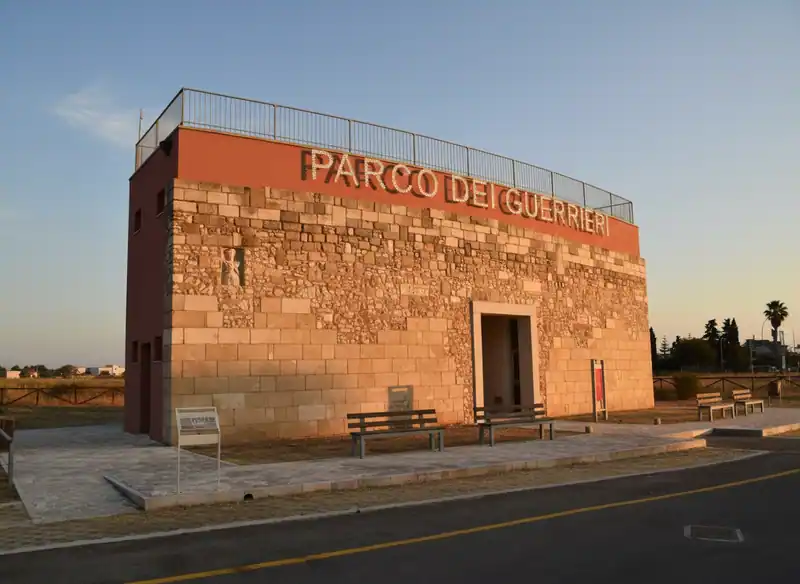
In the countryside near Poggiardo, the Parco dei Guerrieri di Vaste opens a window onto a civilization that thrived long before Rome stamped its name across southern Italy. The Messapians built their settlements here centuries before the legions arrived, and the archaeological park preserves the stone foundations, defensive walls, and everyday traces of a people whose language and customs have largely vanished into time. Walking these grounds feels like reading a story written in fragments each excavated wall, each pottery shard, a clue to a world that modern Puglia has built over but never quite forgotten.
Stones That Speak of Forgotten Kingdoms
The ruins at Vaste aren't grand columns or marble temples; they're humble stone footprints of houses, streets, and fortifications that once defined a thriving Messapian town. Archaeologists have uncovered layers dating back to the Iron Age, revealing how successive generations adapted the same hilltop for defense and community. You'll see the outlines of residential quarters, traces of ancient roadways, and sections of defensive walls that once kept invaders at bay.
Interpretive signs dot the pathways, offering context in Italian, but even without perfect translation the spatial logic of the settlement is clear. The Messapians chose this elevated ground for visibility and protection, and standing where they stood, you can still scan the surrounding plains much as a sentinel might have done two millennia ago.
What the Earth Reveals
The park's excavations have unearthed pottery, tools, and jewelry that now reside in regional museums, but the real treasure here is the layered stratigraphy itself the way one culture's floor becomes another's foundation. The site shows continuous habitation from the Messapian period through the Roman era and beyond, a palimpsest of occupation that mirrors Puglia's broader history of Greeks, Romans, Byzantines, and Normans.
Visitors often find themselves pausing at the ipogei underground chambers carved into the limestone bedrock, used variously as tombs, storage, or refuge. These spaces stay cool even in high summer and offer a tactile connection to ancient hands that shaped the rock.
Planning Your Visit and What to Pair It With
The park is open-air and largely unshaded, so early morning or late afternoon visits are most comfortable, especially in summer. Wear sturdy shoes; the terrain is uneven and scattered with loose stones. Bring water and a hat there are no facilities on-site.
Combine your visit with the nearby town of Poggiardo, where the Museo di Archeologia holds many of the artifacts excavated from Vaste. Just a few kilometers south, the coastal towns of Castro and Santa Cesarea Terme offer dramatic cliffside views and thermal springs, making it easy to pair ancient history with Adriatic beauty in a single day.
- Walk the perimeter walls to grasp the settlement's original scale and defensive strategy
- Look for the carved rock chambers (ipogei) that served as tombs and storage
- Visit in spring when wildflowers soften the stony landscape and temperatures are mild
- Combine with Castro, a short drive away, for seaside lunch and cave explorations
- Check the Poggiardo museum to see pottery, bronze fibulae, and other finds from the site