
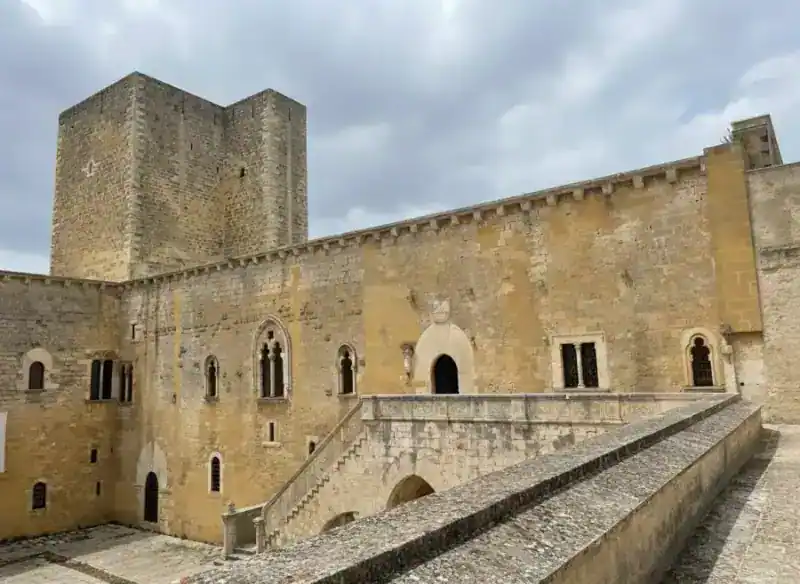
Rising from the heart of Gioia del Colle in the Murge plateau, the Castello normanno-svevo is a masterclass in medieval military architecture. Built by the Normans in the 11th century and transformed by Frederick II of Swabia, this fortress stands as one of Puglia's most eloquent stone narrators, its walls echoing with the strategies and stories of a region fought over for millennia. Unlike the coastal castles that dot the Adriatic and Ionian shores, this inland stronghold was designed to control trade routes and watch over the fertile plains below.
Layers of Stone, Layers of Time
The castle's silhouette is unmistakable: massive corner towers that seem to grow from the bedrock itself, crenellated walls that shift from honey to rose depending on the light, and a courtyard that has witnessed Norman knights, Swabian emperors, and Aragonese lords. Each ruler left their mark in stone, turning the fortress into a palimpsest of power. The Swabian renovations under Frederick II are particularly striking, with refined Gothic details that contrast beautifully with the rougher Norman foundations.
Inside, the National Archaeological Museum occupies the castle's halls, displaying finds from the surrounding Peucetian settlements. You'll find yourself walking through rooms where emperors once strategized, now filled with ancient ceramics and funerary goods that predate even the Normans.
What the Walls Whisper
The true magic of this fortress lies in its details. As you explore, watch for the architectural evolution written in the stonework itself:
- The octagonal towers a signature of Frederick II's castles across Puglia, designed for both defense and elegance
- Arrow slits and machicolations that reveal medieval defensive ingenuity
- Vaulted chambers with cross-ribbed ceilings that create unexpected acoustic effects
- The imperial hall where legend says Frederick II's wife, Bianca Lancia, gave birth to Manfredi
- Views from the ramparts stretching across the Murge toward the distant Adriatic
Beyond the Battlements
Gioia del Colle rewards those who linger. The town is renowned for its mozzarella di Gioia del Colle DOP, a creamy treasure worth seeking in local caseifici. After exploring the castle, wander the historic center's narrow streets, where baroque palaces lean close and elderly locals still gather in doorways for the evening passeggiata.
The castle sits roughly midway between the coastal charms of the Ionian and the trulli villages of the Itria Valley, making it an ideal stop for those tracing a less-traveled route through inland Puglia. Spring and autumn bring the Murge landscape to life with wildflowers and golden light the best times to see the fortress in its most photogenic mood.