
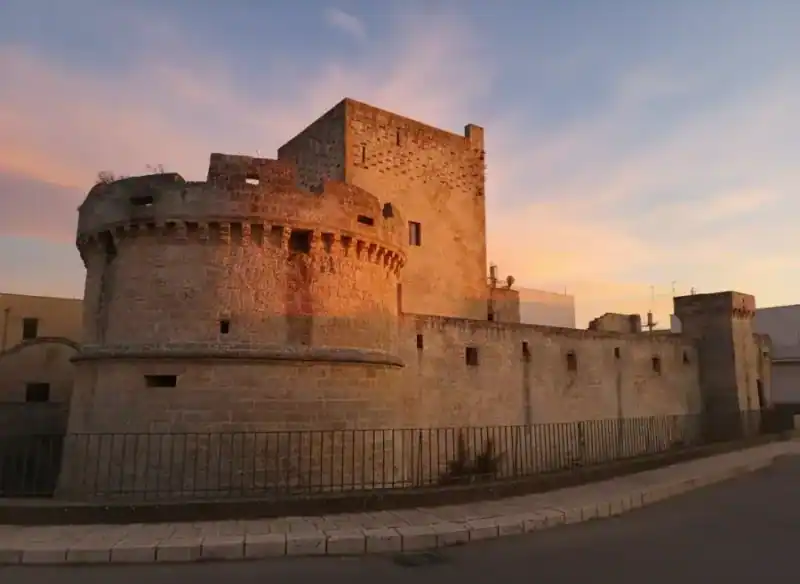
Rising from the sun-bleached streets of Avetrana in the province of Taranto, the Norman Castle stands as a silent sentinel of medieval power and ambition. This fortified complex, built by Norman invaders who swept through southern Italy in the 11th century, tells the story of a turbulent era when stone walls and watchtowers were the only defense against raiders and rival lords. Walking through its ancient courtyard, you can almost hear the clatter of armored knights and the shouts of watchmen scanning the flat plains beyond.
Stone Sentinels and Defensive Genius
The castle's architecture is a masterclass in medieval military engineering. Thick stone walls, weathered by centuries of Puglian sun and wind, rise abruptly from the town center, punctuated by cylindrical towers that once allowed defenders a 360-degree view of approaching threats. The stonework itself tells a story: massive blocks hewn from local quarries, fitted together with the precision of Norman craftsmen who knew that survival depended on impenetrable defenses.
Unlike the more ornate castles of northern Europe, this fortress is all function no frills, no decorative flourishes. Every arrow slit, every crenellation, every vaulted chamber was designed with a single purpose: control of the surrounding territory.
Echoes of a Feudal Past
As you wander through the castle's chambers and walkways, the weight of history presses close. This was once the nerve center of local feudal power, where lords dispensed justice, collected taxes, and planned military campaigns. The castle changed hands multiple times over the centuries, each new owner adding their own modifications a window here, a reinforced wall there creating a layered architectural palimpsest.
The interior spaces, though austere, reveal glimpses of daily medieval life. Look for the vaulted stone ceilings that kept rooms cool in summer and bearable in winter, and the narrow staircases that twist upward into the towers, where guards once kept watch over the roads leading to the coast.
What to Experience
- Climb the towers for sweeping views over Avetrana's rooftops and the agricultural plains stretching toward the Ionian coast
- Study the defensive features arrow slits, murder holes, and reinforced gates that made this fortress nearly impregnable
- Photograph the weathered stone textures and play of light and shadow in the inner courtyard, especially in late afternoon
- Notice the architectural layers that reveal centuries of modifications and adaptations
- Visit in spring when wildflowers push through cracks in the ancient stones, softening the fortress's stern lines
Beyond the Castle Walls
Avetrana itself rewards exploration. This working agricultural town, far from the tourist trails, offers an authentic slice of inland Puglia life. The weekly market spills through the streets near the castle, offering local produce, cheeses, and the earthy rhythm of everyday commerce. Just a short drive away, the wetlands of the Salina dei Monaci provide a striking contrast a coastal nature reserve where pink flamingos wade through shallow lagoons.
The castle also makes an excellent starting point for exploring the broader Tarantine region. The baroque beauty of Martina Franca lies to the northwest, while the coastal town of Manduria, famous for its Primitivo wines, is just minutes away. History enthusiasts will appreciate that the ancient Greek ruins of Manduria's Messapian walls and the mysterious Fonte Pliniano are close enough to combine in a single day of discovery.