
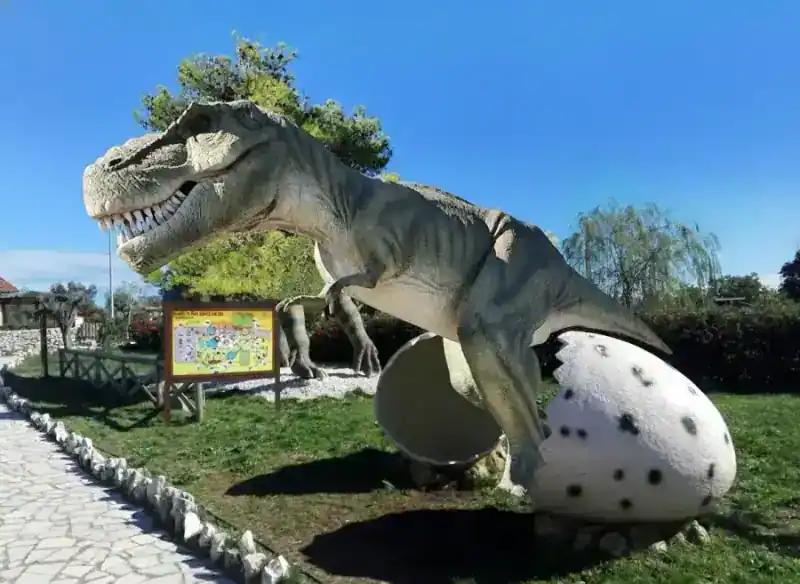
Tucked into the countryside of Borgo Celano, the Museo Paleontologico dei Dinosauri opens a window onto a world that vanished millions of years before the first olive groves took root in Puglia. This is where ancient seas once teemed with life, where dinosaurs roamed, and where every fossil tells a story of transformation. The museum transforms a quiet corner of Foggia province into a paleontological crossroads, making it one of the region's most unexpected treasures for anyone curious about the deep past.
Walking Among Giants
The exhibition halls unfold like chapters in a planetary epic, with life-sized reconstructions standing sentinel over genuine fossil specimens. You'll find yourself face-to-face with predators that stalked ancient landscapes and herbivores whose footprints have been preserved in stone for eons. The lighting is theatrical yet reverent, casting shadows that make each skeleton feel alive again.
Interactive displays invite hands-on exploration, transforming abstract geological time into something tangible. Children press buttons to hear a Tyrannosaurus roar; adults linger over microscope stations examining fossilized teeth and bone fragments. Every corner rewards curiosity with another layer of discovery.
The Story Written in Stone
What sets this museum apart is its commitment to telling the local story. Puglia's limestone bedrock is a paleontological archive, and the exhibits trace the region's own journey from prehistoric seabed to sun-drenched peninsula. Fossilized ammonites and ancient marine reptiles reveal that what is now wheat fields and vineyards was once an ocean floor teeming with life.
- Authentic fossil specimens unearthed from sites across southern Italy
- Interactive touch screens that reconstruct ancient ecosystems
- Life-sized dinosaur models that ignite the imagination
- Detailed geological timelines spanning millions of years
- Educational panels in multiple languages, making science accessible
Beyond the Bones
Plan at least two hours to do justice to the collection more if you're traveling with young paleontologists in training. The museum sits within easy reach of the Gargano promontory to the north, where limestone cliffs and coastal caves offer their own geological marvels. Consider pairing your visit with a drive through the Tavoliere delle Puglie, the vast plains that stretch toward the Adriatic, where the landscape still whispers of ancient seas.
The museum works beautifully as a rainy-day escape or a midday break from the summer heat. Photography is encouraged, so bring your camera to capture the drama of those towering skeletons. Arrive early on weekends to avoid school groups, or embrace the energy there's something contagious about a child's wonder at seeing a dinosaur for the first time.