
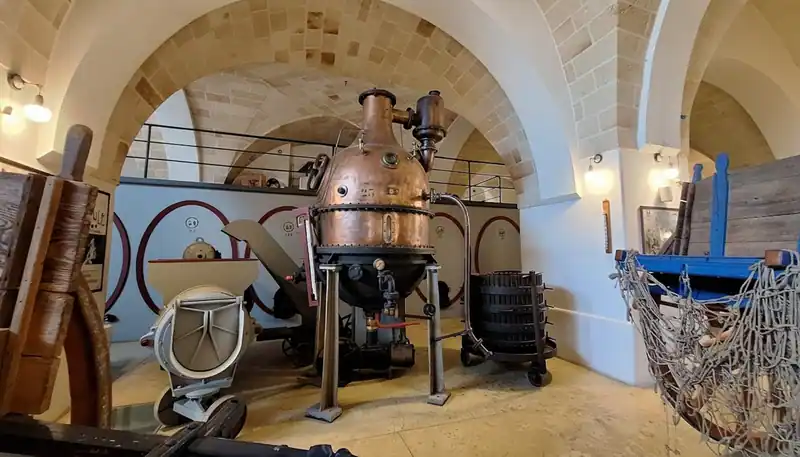
In the heart of Manduria, where the vines of Primitivo di Manduria have shaped the landscape for centuries, a small museum tells the story of a wine that has become synonymous with Puglian identity. The Museo della Civiltà del Vino Primitivo is more than a collection of artifacts—it's a journey into the soul of a territory where viticulture isn't just agriculture, but a way of life passed down through generations.
A Living Archive of Vine and Vintage
The museum unfolds across intimate exhibition rooms that feel less like galleries and more like the workshops and cellars of the contadini who once tended these ancient vines. Here you'll find traditional winemaking tools that tell the story of labor and love: worn wooden presses, terracotta amphorae, and hand-forged pruning shears that have shaped the region's wine for centuries. Each object carries the fingerprints of farmers who understood the land in ways no textbook could teach.
Interactive displays trace the evolution of Primitivo cultivation from its mysterious origins—some say the grape arrived from Croatia, others claim it's truly native—to its modern renaissance as one of Italy's most celebrated red wines. You'll discover how Manduria's unique iron-rich red soil and scorching summer sun create the conditions for the grape's signature intensity.
The Primitivo Terroir Experience
What sets this museum apart is its focus on terroir—the inseparable relationship between wine, soil, and culture. Detailed maps show the patchwork of family vineyards that surround Manduria, many still trained in the traditional alberello bush-vine system, a UNESCO-recognized technique that keeps clusters low to the ground, concentrating flavor under the Puglian sun.
Multimedia exhibits bring the harvest to life: the voices of elderly vignerons recounting September mornings in the vineyard, the rhythms of hand-picking, the communal rituals of pressing and fermentation. It's a sensory portal into a world where wine was currency, celebration, and survival all at once.
Beyond the Cellar Walls
The museum works beautifully as an anchor for exploring Manduria's wine country. After your visit, the historic center beckons with its Baroque churches and piazzas shaded by ancient olive trees—many of the cafés pour local Primitivo by the glass. Within a short drive, you can visit working wineries offering tastings in centuries-old masserie, or explore the nearby Parco delle Mura Messapiche, where pre-Roman walls remind you that this land has been cultivated for millennia.
Consider combining your museum visit with a trip to the coast: the Ionian beaches of Torre Colimena and San Pietro in Bevagna are just twenty minutes away, offering a perfect contrast of sea and vine.
Insider Tips for Your Visit
- Visit in late morning when natural light floods the exhibition halls, making the displays easier to photograph
- Ask about occasional guided tastings and workshops held in partnership with local wineries—they're not always advertised online
- The museum is compact, so plan 45–60 minutes; it pairs perfectly with a lunch of bombette and Primitivo at a nearby trattoria
- September through October is harvest season—the museum often hosts special events celebrating vendemmia
- Combine your visit with the town's ancient Jewish quarter and the impressive Fontana del Formale, Manduria's Renaissance fountain