
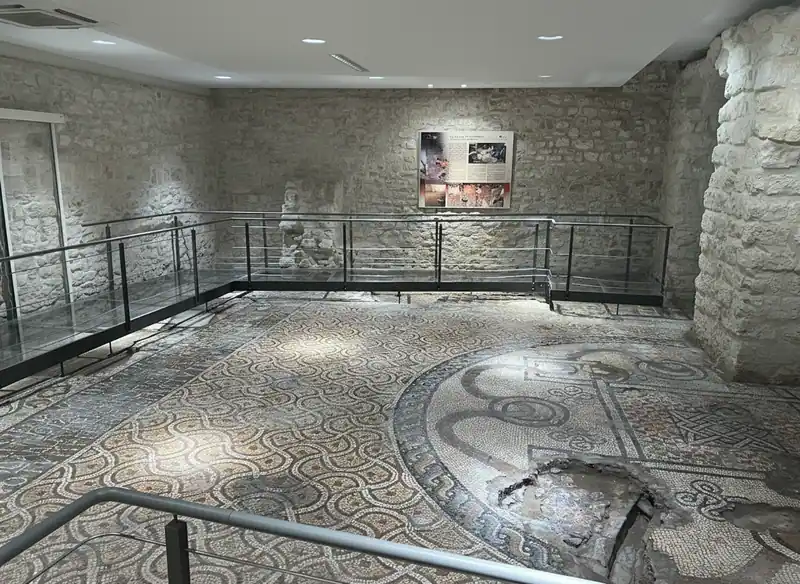
Beneath the soaring arches of Bari's cathedral lies a world most visitors never see—a hushed, dimly lit sanctuary where centuries collapse into layers of stone and mosaic. The Museo del Succorpo della Cattedrale invites you to step down into the foundations of faith itself, where early Christian communities left their mark in fragments of stunning artistry and devotion. This is Bari at its most intimate, a city peeling back its own skin to reveal the bones of its past.
Descending into sacred memory
The museum entrance feels almost secret, tucked within the cathedral complex in the heart of Bari Vecchia. As you descend the worn stone steps, the temperature drops and the air thickens with the weight of history. The underground chambers sprawl in unexpected directions, revealing early Christian mosaics that have survived floods, earthquakes, and the relentless passage of time.
These aren't polished museum pieces behind glass—many are in situ, exactly where they were laid more than a millennium ago. You're walking on the same ground where pilgrims once knelt, where bishops consecrated altars, where the city's spiritual life took root.
Fragments of devotion and daily life
The collection is small but profoundly moving. Sculptural fragments from Byzantine and Romanesque periods lean against ancient walls, their carvings still crisp despite centuries underground. Funerary inscriptions whisper names long forgotten, while fragments of columns hint at the grandeur of earlier basilicas that once occupied this sacred site.
- Mosaic floors depicting geometric patterns and early Christian symbols, their tesserae still vibrant in ochre, terracotta, and cream
- Carved reliefs showing saints, vines, and peacocks—symbols of resurrection and eternal life
- Architectural remnants from at least three earlier churches, each built atop the ruins of the last
- Traces of medieval frescoes clinging to damp stone, ghostly faces emerging from plaster
- Stone altars and baptismal fonts that once anchored the rhythms of medieval worship
Bari's layered soul
What makes the Succorpo extraordinary isn't just what's preserved—it's the sense of continuity. Bari has always been a crossroads, a port city where East met West, where Byzantine emperors, Norman knights, and Levantine merchants mingled in the streets above. Down here, those layers become literal, stacked one atop another in stone and mortar.
The museum is small enough to explore in thirty minutes, but it rewards slow contemplation. Linger in the cool shadows, let your eyes adjust, and notice the subtle play of light on ancient surfaces. Combine your visit with a walk through the cathedral above—the contrast between the airy Romanesque nave and the subterranean chambers deepens the experience of both.
When to visit and what to explore nearby
The museum is rarely crowded, even in summer, making it a perfect retreat from the midday heat. After your visit, step outside into Piazza dell'Odegitria and lose yourself in the maze of Bari Vecchia's narrow alleys, where grandmothers still roll orecchiette by hand in open doorways. The Basilica di San Nicola is a five-minute walk, and the lungomare—Bari's elegant seafront promenade—is just beyond, perfect for an evening passeggiata as the Adriatic turns gold.
This isn't a museum that shouts for attention. It whispers, and in that quietness, Bari's deepest stories come alive.