
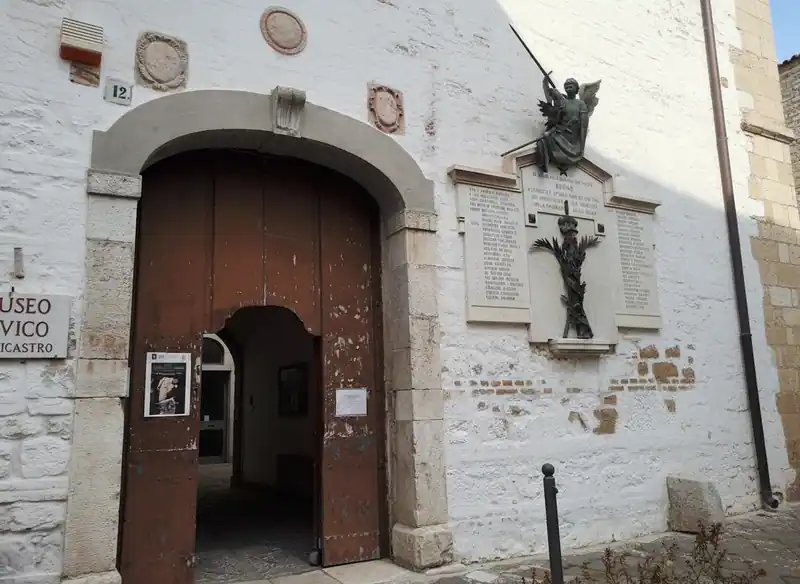
Perched in the medieval hill town of Bovino, in the province of Foggia, the Museo Archeologico "Carlo Gaetano Nicastro" offers a intimate journey through the ancient settlements that shaped this corner of northern Puglia. The museum's modest scale belies the richness of its collection, with artifacts spanning millennia that speak to the enduring human presence in these hills.
Layers of civilization in pottery and stone
The museum's display cases present a carefully curated selection of pottery fragments, tools, and decorative objects that chronicle the region's evolution from prehistoric times through the Roman era. Each piece tells a story of daily life, trade routes, and artistic traditions that connected Bovino to broader Mediterranean cultures. The glazed ceramics and household implements reveal how communities adapted to the rugged terrain and built thriving settlements along ancient pathways.
The quiet dignity of a small-town collection
Unlike the grand archaeological museums of Taranto or Bari, this civic collection maintains an unpretentious, neighborhood feel that encourages close observation. The exhibits are labeled with care, often drawing connections between ancient practices and the agricultural rhythms that still define life in the surrounding countryside. Walking through the rooms feels less like a formal museum visit and more like an afternoon spent in conversation with a local historian who knows every artifact by heart.
- Study the terracotta figurines that hint at religious practices and domestic rituals
- Examine flint tools and bronze implements that show the craftsmanship of early metalworkers
- Notice the continuity between ancient storage jars and the giare still used in local cellars
- Look for Roman-era coins and inscriptions that place Bovino on the map of imperial trade
Exploring the medieval town beyond the museum
After your visit, wander Bovino's steep cobbled streets, where Norman castle ruins and Romanesque churches create layers of history visible at every turn. The town sits on a dramatic ridge with views stretching to the Tavoliere plains and the distant Gargano massif. Combine the museum with a meal at one of the family-run trattorie serving caciocavallo podolico and handmade orecchiette, products of the same pastoral landscape that sustained the ancient peoples whose artifacts fill the museum's cases.
The museum welcomes visitors year-round, though spring and autumn bring the most comfortable weather for exploring both the collection and the hill town's medieval fabric. The quiet galleries reward patience, inviting you to read the visual language of pottery shards and corroded bronze as chapters in a continuous human story rooted in this rugged, beautiful terrain.