
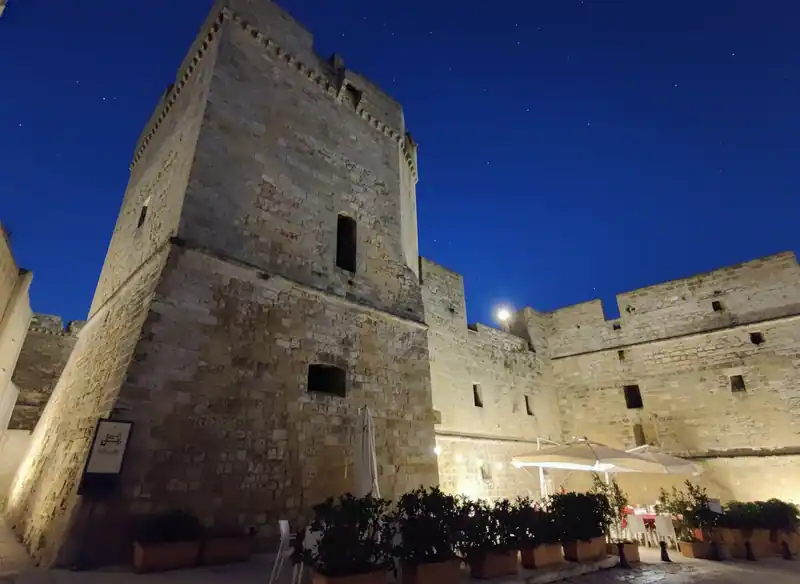
Perched on the clifftops of Castro, one of the Adriatic coast's most dramatic medieval villages, the Museo Archeologico transforms a centuries-old castle into a window onto millennia of human settlement. The panoramic views from the fortifications rival the treasures inside, where Bronze Age pottery, Messapian inscriptions, and Roman relics tell the story of a coastline coveted by sailors and settlers for over three thousand years.
A Castle That Guards Ancient Stories
The museum occupies the historic castello at Castro's highest point, where defensive walls once watched for Ottoman fleets and pirate galleys. Today, the stone halls house carefully curated displays that trace the area's evolution from prehistoric caves to a thriving Messapian port. The building itself is part of the experience narrow spiral staircases, vaulted ceilings, and arrow-slit windows frame the Adriatic in unexpected flashes of blue.
Stepping from exhibit to exhibit feels like moving through centuries. Glass cases hold ceramic fragments from Greek traders, bronze fibulae worn by Messapian noblewomen, and amphorae that once carried wine and olive oil across the Mediterranean.
Treasures From the Grotta Zinzulusa and Beyond
Many of the museum's most striking pieces come from the nearby Grotta Zinzulusa, a sea cave where Neolithic communities left tools, pottery, and ritual objects. The delicate stone implements and bone carvings speak to the ingenuity of early coastal dwellers who fished these waters long before written records began.
- Messapian inscriptions carved in the ancient Italic language, offering rare glimpses of pre-Roman culture
- Roman amphorae recovered from shipwrecks along Castro's rocky shores
- Bronze Age pottery decorated with geometric patterns still vivid after millennia
- Medieval ceramics showing Byzantine and Norman influences
- Panoramic terraces where you can photograph the coastline stretching toward Santa Cesarea Terme
Wander Castro's Stone Lanes After Your Visit
The museum sits in the heart of Castro Superiore, the medieval hilltop quarter where whitewashed houses cascade down stone alleys. After exploring the exhibits, lose yourself in the labyrinth of staircases and archways that spill toward the harbor below. The Chiesa dell'Annunziata is a five-minute walk, its baroque façade hiding a cool, frescoed interior perfect for a quiet moment.
Combine your visit with a morning at Castro Marina, where fishing boats bob in the tiny port and seaside restaurants serve ricci di mare so fresh they're still briny. The Grotta Zinzulusa lies just three kilometers south book a boat tour to see the stalactites and underground pools that yielded many of the museum's treasures. If you're driving, the coastal road toward Otranto offers jaw-dropping viewpoints every few hundred meters, especially near sunset.
Time Your Visit for Golden Hour
The castle's western ramparts catch the late afternoon sun beautifully, bathing the limestone walls in honey-colored light. Arrive an hour before closing to enjoy the exhibits without crowds, then linger on the terrace as the sky turns pink over the Adriatic. Castro's compact size means you can easily explore the museum, stroll the old town, and dine by the harbor all in a single unhurried afternoon.