
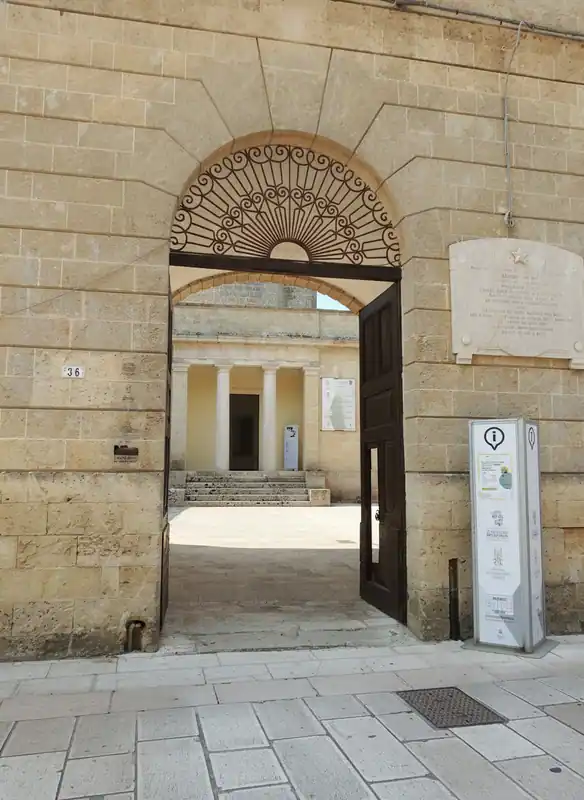
In the quiet heart of Patù, a small town perched between the Ionian Sea and ancient olive groves, the MAV Archaeological Museum opens a window onto millennia of human settlement. This collection brings together pottery fragments, bronze tools, and everyday objects from the vanished city of Vereto, an ancient Messapian settlement that once thrived just outside the modern town. Walking through these rooms, you're tracing the footsteps of farmers, artisans, and traders who shaped this corner of Puglia long before the baroque splendor of Lecce or the coastal watchtowers were ever imagined.
Voices from Vereto's Past
The museum's name honors Vereto, a settlement mentioned by ancient historians and rediscovered through decades of excavation. The displays are modest in scale but rich in narrative each ceramic shard and bronze fibula tells a story of daily rituals, trade routes, and craft traditions. You'll see amphorae that once held wine destined for distant markets, loom weights that hint at textile production, and votive offerings left at long-forgotten shrines.
Interpretive panels (in Italian, with some English) place the artifacts in context, linking them to the broader Messapian culture that flourished across the peninsula. The museum staff, often locals with deep knowledge of the area's archaeology, are eager to share insights and answer questions.
Details That Speak Volumes
One of the museum's strengths is its focus on the small, intimate objects that reveal how people actually lived. Look for the delicate bone needles, the painted pottery decorated with geometric patterns, and the iron tools that would have been used to cultivate the same red earth that surrounds Patù today. These aren't grand statues or towering columns they're the things people held in their hands every day.
- Messapian pottery with intricate designs that echo Greek influences
- Bronze fibulae and jewelry that adorned local residents centuries ago
- Agricultural tools that show continuity between ancient and modern farming
- Votive offerings from sacred sites around Vereto
Pairing History with Coastal Beauty
After exploring the museum, step outside into Patù's compact historic center, where narrow lanes lead past whitewashed houses and the curious Centopietre, a rare rectangular tomb-monument from the 9th century. The Ionian coast is just a few kilometers away Torre San Gregorio and the crystalline waters of Felloniche make perfect companions to a morning of archaeology. Many visitors combine the museum with a drive through the Serre Salentine hills, stopping at the nearby sanctuary of Santa Maria di Leuca.
The museum is small enough to visit in under an hour, making it an ideal rainy-day detour or a cultural pause between beach days. Entry is free, and the intimate scale means you can linger over the pieces that fascinate you most without feeling rushed.