
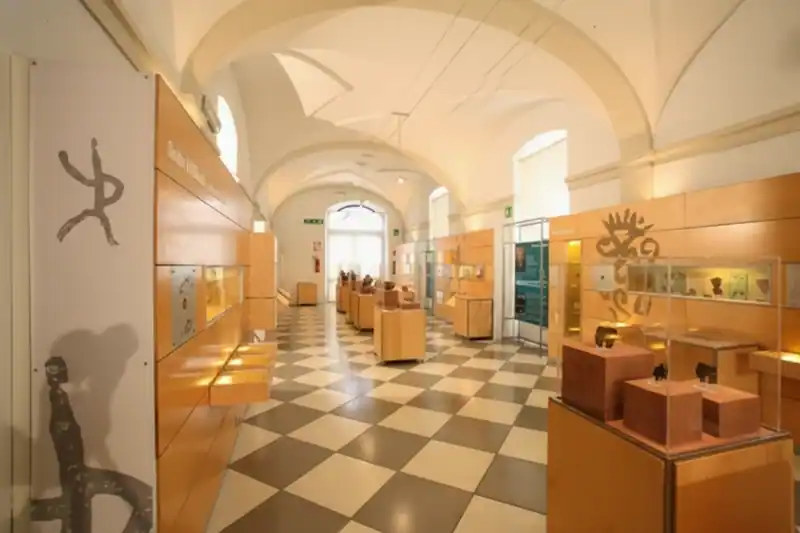
Tucked into the historic heart of Maglie, the Museo Civico di Paleontologia e Paletnologia Decio de Lorentiis offers a rare window into deep time. This compact museum bridges the vast sweep of natural history with the intimate story of human settlement across southern Puglia, making it a standout cultural gem in the province.
Fossils That Tell Ancient Stories
The paleontological collection is the museum's crown jewel. Here you'll encounter fossils that date back millions of years, each specimen a frozen moment from when this Mediterranean landscape looked utterly different.
Glass cases display marine invertebrates, ancient shells, and mineralized remains that once thrived in prehistoric seas. The careful curation helps even casual visitors grasp the region's geological transformation over eons.
- Mesozoic-era ammonites with perfect spiral chambers
- Fossilized corals and sea urchins from ancient reefs
- Vertebrate remains that hint at vanished ecosystems
- Explanatory panels in Italian that contextualize each geological period
Human Heritage Preserved in Stone and Clay
The ethnographic and archaeological sections shift the timeline forward to human scale. Artifacts from Neolithic settlements, Bronze Age tools, and ceramic fragments trace the footsteps of the people who shaped this land long before modern towns emerged.
The collection includes worked flints, pottery shards with geometric patterns, and everyday objects that make the distant past feel tangible. You'll see how early communities adapted to the limestone plateaus and coastal plains of Puglia.
A Quiet Space for Curious Minds
Unlike larger regional museums, this institution maintains an intimate, almost contemplative atmosphere. The modest scale means you can linger without feeling rushed, making it ideal for anyone who prefers focused exploration over crowded galleries.
The building itself reflects Maglie's understated elegance. Natural light filters through tall windows, illuminating display cases without glare. Wooden floors creak softly underfoot, adding to the sense of stepping into a private archive.
Plan to spend around an hour if you read most labels, or half that for a quick sweep. Pair your visit with a stroll through Maglie's baroque center the Church of Madonna delle Grazie and Palazzo Capece are both within a five-minute walk.
Tips for Getting the Most from Your Visit
Spring and autumn are ideal seasons to visit Maglie, when the town hosts cultural events and the weather suits long walks between sites. Mornings tend to be quieter at the museum, giving you space to absorb the exhibits without distraction.
- Bring a notebook if you're a keen learner labels are detailed but not always in English
- Photography is usually allowed, perfect for geology enthusiasts documenting specimens
- Combine with nearby Corigliano d'Otranto castle or Carpignano Salentino's Byzantine frescoes for a full day of history
The museum honors the legacy of Decio de Lorentiis, a local scholar whose passion for natural history seeded this collection. His spirit of curiosity still permeates the halls, inviting visitors to see Puglia not just as a sun-drenched coastline, but as a land layered with millions of years of life.