
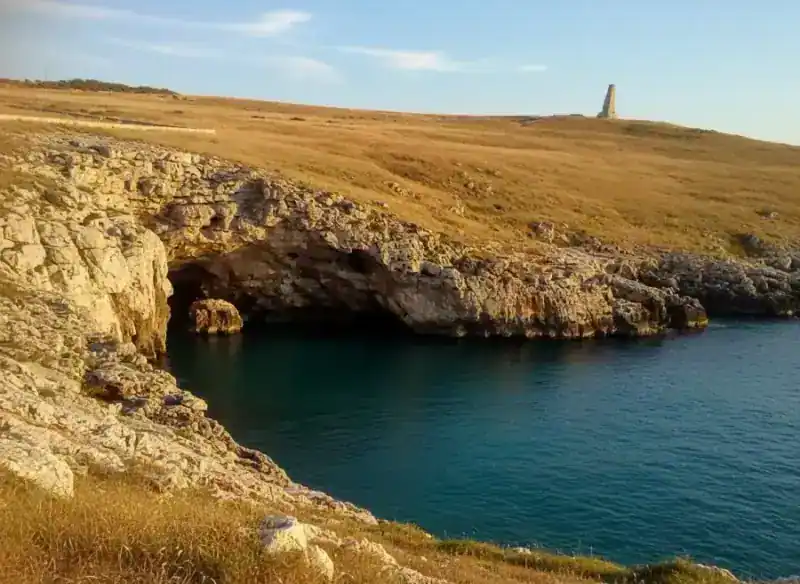
The Grotte dell'Orte rise from the Adriatic just north of Otranto, where centuries of waves have carved a labyrinth of sea caves into towering limestone cliffs. Reaching them by boat feels like stepping into a geological secret, where the water glows in shades of sapphire and jade and the air smells of salt and ancient stone.
A Cathedral of Stone and Light
These caves are not polished tourist attractions they are raw, elemental, and alive with the sound of the sea. The entrance arches open like Gothic portals, tall enough to pass under by boat, their walls streaked with minerals that shimmer in the refracted sunlight. Inside, the water is impossibly clear, revealing every ripple of sand and rock below, and the limestone overhead forms natural vaults and ridges that echo with the slap of waves.
Some caverns are shallow and bright, perfect for a quick swim. Others tunnel deeper into the cliff face, cool and shadowed, where shafts of light pierce through cracks and paint the water in shifting patterns.
The Journey by Boat
Most visitors arrive by gommone or small motorboat rented from Otranto's harbor, a ten-minute ride north along the coast. The approach is half the magic: the cliffs rise sheer from the sea, dotted with wild thyme and fig, and the caves reveal themselves only as you draw close. A handful of local operators run guided tours that loop through the grottoes, pausing for swimming and storytelling about smugglers and fishermen who once used these caves as refuge.
- Crystal-clear water makes snorkeling a revelation schools of small fish dart through the shallows, and the rocky bottom is etched with light.
- Natural acoustics inside the larger caves amplify every sound, from voices to the rhythmic wash of the tide.
- Best visited in the morning when the sun is angled to illuminate the cave interiors without the midday glare.
- Bring a waterproof camera the play of light on stone and water is irresistible.
The Masseria Above and the Coast Beyond
The caves take their name from the nearby Masseria dell'Orte, a historic fortified farm perched on the headland above. Though the masseria itself is private, the coastal path that skirts it offers panoramic views down to the water and across to the white walls of Otranto's old town, less than three kilometers south. Combine a cave visit with a morning exploring Otranto's cathedral and its Byzantine mosaic floor, or push further north to the Baia dei Turchi, a crescent of sand backed by pines where the Adriatic meets the shore in gentle crescents.
The sea here is wilder than the sheltered coves of the Ionian coast wind and waves have shaped these rocks for millennia, and the result is a landscape that feels both timeless and untamed.