
In the heart of Manduria, a Puglian town famed equally for its robust Primitivo wine and its deep historical roots, stands one of southern Italy's most evocative pre-Roman sites. The Parco Archeologico delle Mura Messapiche invites you to walk alongside defensive walls that once guarded a thriving Messapian settlement. These ramparts, raised centuries before Rome ever extended its reach this far south, are more than stone and mortar they are the silent witnesses to a sophisticated civilization that flourished on the crossroads between the Adriatic and Ionian seas.
Stone Sentinels of a Vanished Kingdom
The fortifications that define this park are nothing short of monumental. Built in multiple phases from the 5th to the 3rd century BCE, the walls stretch across the landscape in massive blocks of local limestone, some sections rising nearly five meters high. Their sheer scale speaks to the Messapians' determination to protect their town from rival tribes and Greek colonists alike.
As you trace the perimeter, you'll notice the triple-ring structure: three concentric circuits of walls, a defensive strategy that made Manduria one of the most impregnable settlements of its era. The outer circuit alone spans over three kilometers, and walking even a portion of it offers a visceral sense of ancient scale and ambition.
Where History Emerges from the Earth
The park is not merely walls. Archaeological excavations have revealed necropolis areas, the foundations of dwellings, and fragments of pottery that hint at daily life in this Iron Age hub. Information panels guide you through the chronology and significance of each zone, though much of the magic lies simply in wandering the grassy paths and letting your imagination reconstruct the bustling town that once thrived here.
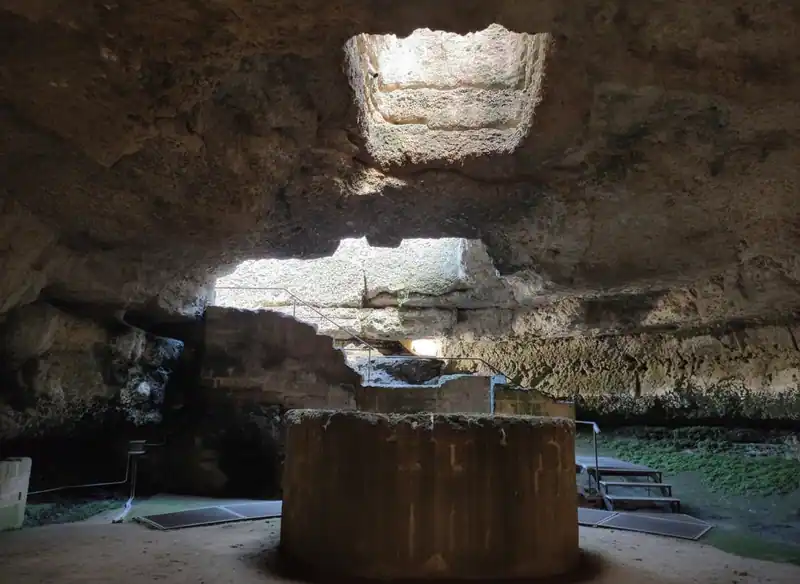
Don't miss the nearby Fonte Pliniano, a natural spring enclosed within an ancient well chamber. Pliny the Elder himself wrote of Manduria's water sources, and standing before this subterranean pool its surface still and dark, reflecting vaulted stone you feel the weight of centuries pressing in.
Practical Magic and Nearby Treasures
Entry to the park is free, making it an ideal stop for history enthusiasts, families, and anyone curious about Puglia's layered past. Bring sturdy shoes; the terrain is uneven in places, and summer sun can be fierce with little shade. Early morning or late afternoon light transforms the honey-colored stone into something almost golden, perfect for photography.
- Combine your visit with a tasting at one of Manduria's renowned cantine, where the Primitivo grape reaches its full, velvety potential
- Explore the historic centro storico, where baroque churches and narrow vicoli reveal centuries of architectural evolution
- Head fifteen kilometers south to the Ionian coast Torre Colimena and the marine reserve of Porto Cesareo offer crystalline waters and protected dunes
- Visit the Museo della Civiltà del Vino Primitivo to understand how viticulture and archaeology intertwine in Manduria's identity
- Pack water and a hat; the site is exposed, and the Puglian sun shows no mercy even in shoulder seasons
A Journey Through Time, Not Just Space
The Messapian Walls are not a polished, heavily curated attraction. There are no costumed guides or multimedia extravaganzas. What you find instead is authenticity: the raw, unvarnished archaeology of a people who built for permanence and defended their world with stone and sweat. This is a place that rewards curiosity and patience, offering its secrets slowly to those willing to linger and listen.
Whether you're a dedicated archaeology buff or simply someone who delights in stumbling upon hidden historical gems, Manduria's ancient walls offer a rare chance to step outside the Renaissance and the Baroque, back into the Iron Age twilight when Puglia's story was still being written in a language Rome had not yet learned.