
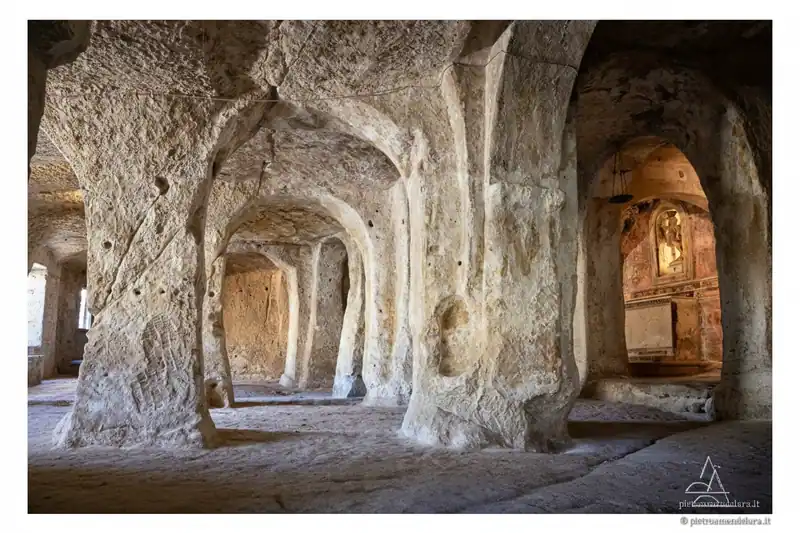
Descend into the limestone cliffs of Gravina in Puglia and you'll find a sacred space that predates the Renaissance by centuries. Chiesa Rupestre San Michele delle Grotte is not merely a church it's a testament to the devotion of early medieval monks who carved their place of worship directly into the living rock, creating a sanctuary that merges human faith with the raw geology of the Murgia plateau.
A Cathedral Carved by Hand
The church emerges from the cliff face like a secret revealed. Byzantine craftsmen hollowed out natural cave formations, transforming rough stone into vaulted chambers and pillars. The result is an intimate worship space where every surface tells a story of patience and spiritual commitment.
Stone altars rise from the cave floor, carved from the same bedrock that forms the walls. The cool, damp air carries a sense of timelessness, as if the prayers of centuries still echo in the shadowed alcoves.
- Byzantine frescoes depicting saints and religious scenes, their pigments remarkably preserved by the cave's stable microclimate
- Hand-carved niches and apses that follow the natural contours of the rock
- Stone benches and kneeling surfaces worn smooth by generations of worshippers
- Natural light filtering through carefully positioned openings, creating dramatic illumination throughout the day
Windows into Medieval Spirituality
The frescoes are the soul of San Michele delle Grotte. These Byzantine paintings executed in earth tones of ochre, burnt sienna, and charcoal depict archangel Michael and scenes from Christian scripture with the stylized elegance characteristic of Eastern Christian art. Despite centuries of weathering, many retain their original vibrancy.
Look closely and you'll notice layers of plaster and paint, evidence of multiple artistic campaigns as successive generations of monks refreshed and added to the sacred imagery. This palimpsest of devotion offers rare insight into evolving religious practices in medieval Puglia.
Beyond the Church Walls
The rupestrian church sits within Gravina's extraordinary landscape of ravines and cave settlements. After exploring San Michele, wander the gravina the deep limestone gorge that gives the town its name where dozens of other cave dwellings, cisterns, and chapels honeycomb the cliffs.
The nearby Madonna della Stella is another stunning rock church worth visiting, while the town's historic center perched above the ravine offers panoramic views and excellent traditional cuisine. Time your visit for late afternoon when golden light transforms the limestone into glowing amber.
Wear sturdy shoes with good grip the approach involves uneven stone steps and potentially slippery surfaces. Bring a flashlight or use your phone's torch to illuminate the darker recesses and appreciate the frescoes' finer details. The cave maintains a constant cool temperature year-round, so a light jacket is advisable even in summer.