
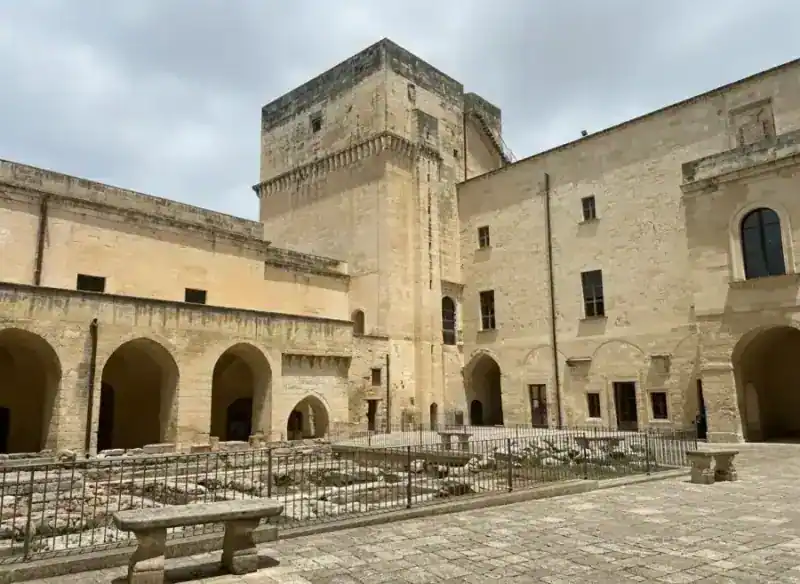
At the eastern edge of Lecce's baroque centro storico, the Charles V Castle stands as a sharp counterpoint to the city's flowing limestone facades. Built in the 1540s on the orders of the Holy Roman Emperor, this fortezza was designed not for beauty but for survival a Renaissance military machine meant to guard the Kingdom of Naples from Ottoman raids. Today, its star-shaped bastions and deep moats tell a story of an era when Lecce was as much a frontier garrison as a cultural capital.
A Fortress Built for War
The castle's architect, Gian Giacomo dell'Acaya, engineered a structure that could withstand cannon fire, a cutting-edge innovation in the 16th century. Unlike the towering medieval keeps of northern Europe, Charles V Castle sprawls low and wide, its thick walls angled to deflect artillery. Walk the perimeter and you'll notice the trapezoidal bastions jutting out at each corner these allowed defenders to fire along the walls without blind spots.
The fossato, or dry moat, once ringed the entire complex. Today it's a grassy promenade where locals jog at dusk, but the sheer scale of the excavation hints at the labor that built it.
What You'll Experience Inside
The castle now hosts rotating exhibitions contemporary art, archaeological finds, and multimedia installations that lean into the contrast between old stone and modern media. The vaulted chambers that once stored gunpowder and grain now serve as gallery spaces, their rough-hewn walls lit by carefully placed spots.
- Panoramic terrace walks along the upper ramparts, with views over Lecce's rooftops and bell towers
- The Sala delle Armi, a cavernous arsenal hall where temporary exhibits play with light and shadow
- Scale models and diagrams in the entrance hall, showing how the castle's defenses evolved over centuries
- A small but well-curated collection of Renaissance weaponry and engineering drawings
Timing Your Visit and Nearby Treasures
The castle is coolest in the morning, when light slants through the narrow embrasures and the courtyards are quiet. Combine your visit with a walk through the nearby Giardino Pubblico, Lecce's green lung, or head west into the tangle of baroque churches Santa Croce and the Duomo are both within ten minutes on foot.
If you're drawn to military history, pair the castle with a drive to the watchtowers that dot the Adriatic coast north of Lecce. The Torre dell'Orso and Torre Sant'Andrea are less than half an hour away, remnants of the same defensive network that Charles V's engineers built to guard Puglia's shores.
Why It Feels Different
What sets this castle apart is the stark materiality no frescoes, no gilded ceilings, just raw stone and geometry. It's a monument to pragmatism, and that austerity makes it a powerful foil to Lecce's exuberant baroque. Couples interested in architecture and history will find it a refreshing counterpoint to the city's sweeter attractions, while anyone fascinated by Renaissance engineering will appreciate the chance to walk inside a textbook example of alla moderna fortification design.