
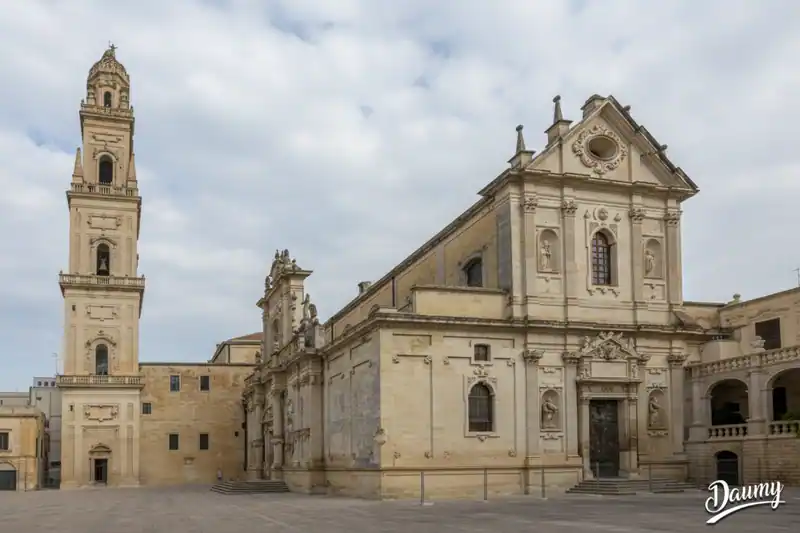
In the heart of Lecce, Piazza del Duomo opens like a hidden theater, and the Cathedral of Saint Mary of the Assumption and Saint Orontius commands the stage. This is one of Puglia's most breathtaking sacred spaces, where Baroque extravagance meets Romanesque restraint in a dialogue that has unfolded over centuries. The cathedral's twin façades one facing the square, the other tucked along the side tell two architectural stories at once, inviting you to linger and decode the layers.
A Square Within a Square
Piazza del Duomo is unlike any other square in Lecce. Enclosed on all sides, it feels almost like a private courtyard, amplifying every footstep and whisper. The cathedral anchors the eastern edge, flanked by the bishop's palace and the bell tower that soars seventy meters skyward.
Step inside, and the nave stretches toward an explosion of gilded chapels, frescoed ceilings, and polychrome marble. The light filters softly through high windows, casting shadows that shift as the day moves from morning mass to evening vespers.
Baroque Layers Over Romanesque Bones
The original cathedral dates to the 12th century, but what you see today is largely the work of Giuseppe Zimbalo, the architect who transformed Lecce's skyline in the 1600s. He rebuilt the façade, raised the bell tower, and filled the interior with the exuberant detail that defines Barocco leccese.
Look closely at the side entrance the older, quieter façade and you'll spot traces of the Romanesque foundation. The contrast between the two faces of the building is a masterclass in how architecture evolves without erasing its past.
What to Look For Inside
Don't rush through. The cathedral rewards slow observation, especially if you arrive when sunlight pours through the transept.
- The crypt of Sant'Oronzo, patron saint of Lecce, rests beneath the main altar pilgrims have venerated his relics here since the 1600s.
- Twelve side altars dedicated to different saints, each a miniature explosion of sculpture, painting, and devotion.
- The wooden choir stalls in the apse, intricately carved and still used during liturgical celebrations.
- Frescoes by Giuseppe da Brindisi, whose work adorns several chapels with scenes from the life of Mary and the saints.
- The bell tower view if open, the climb offers one of the finest panoramas over Lecce's rooftops and the countryside beyond.
Timing Your Visit
The cathedral is free to enter, and it welcomes visitors outside of mass times. Early morning is the most atmospheric locals stop in for a quiet prayer before the square fills with tour groups. Late afternoon, when the sun angles low, the façade glows in shades of honey and rose.
Piazza del Duomo is best explored as part of a walking loop through Lecce's centro storico. From here, the Basilica di Santa Croce is a five-minute stroll north, and the Roman amphitheater lies just beyond Piazza Sant'Oronzo. If you're craving a break, slip into one of the nearby cafés for an espresso and a pasticciotto Lecce's signature custard pastry.