
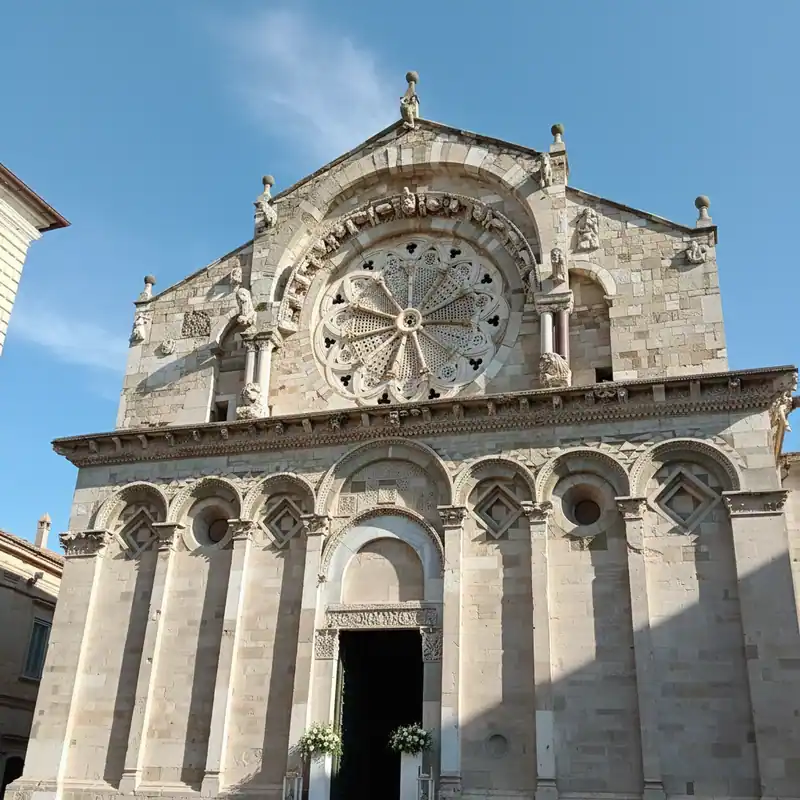
In the heart of Troia, a medieval hilltop town in the Province of Foggia, the Cathedral Basilica of Santa Maria Assunta rises like a testament to faith and artistry. Its facade alone tells a thousand-year story, where Romanesque austerity meets the drama of later Baroque interventions. This is not a monument frozen in time but a living sanctuary that has evolved across centuries, inviting visitors to trace the layers of devotion carved into stone and painted onto vaulted ceilings.
A Portal Between Eras
The cathedral's entrance is an architectural masterpiece in itself, featuring an intricately carved rosone that filters light into kaleidoscopic patterns across the nave. Step inside and you'll find yourself beneath arches that date back to the 11th century, their pure lines softened by later additions of gilded altars and frescoed chapels. The contrast is striking: where medieval builders aimed for heaven through simplicity, Baroque artists filled every surface with angels, saints, and swirling clouds.
Look up to see how ribbed vaults spring from Romanesque columns, creating a rhythm that draws the eye toward the apse. The light here shifts throughout the day, and locals say the cathedral's true character reveals itself best in the golden hour before sunset, when the western windows glow like amber.
Treasures Hidden in Plain Sight
Beyond the grand impression of scale and decoration, the cathedral rewards patient exploration. The crypt beneath the main floor is a hushed, almost mystical space where the original Romanesque structure remains largely untouched. Stone capitals carved with fantastical creatures and plant motifs reveal the medieval imagination at work.
- The bronze doors panels depicting biblical scenes with remarkable detail, worn smooth by centuries of touch
- The bishop's throne a marble seat from the 12th century, its armrests sculpted with lions
- Frescoes in the side chapels showing local saints and miracles specific to Troia's history
- The carved wooden choir stalls, each panel a miniature work of art
- The treasury room, where vestments and chalices tell the story of the diocese's wealth and influence
The Town That Rose Around It
Troia itself grew in the orbit of this cathedral, which served not just as a place of worship but as a political and cultural anchor for the region. The piazza that stretches before the facade has been a gathering place for markets, festivals, and processions since the Middle Ages. Today, it remains the beating heart of town life, especially during feast days when the cathedral's bells ring out across the valley.
Combine your visit with a walk through Troia's narrow streets, where stone houses lean toward one another and small workshops still produce traditional crafts. Just a few kilometers away, the rolling hills of the Tavoliere plain stretch toward the horizon, dotted with wheat fields and ancient farmhouses. For those exploring the wider Province of Foggia, Troia makes an excellent base for discovering lesser-known Puglian gems hilltop sanctuaries, Norman castles, and agriturismi serving pasta made by hand each morning.
When to Step Inside
The cathedral welcomes visitors year-round, but spring and autumn bring the most comfortable temperatures for wandering both the interior and the surrounding medieval quarter. Early morning visits offer a chance to see the church in quiet contemplation, before tour groups arrive. If you're fortunate enough to be in Troia during a liturgical celebration, the experience becomes even more profound the acoustics carry Gregorian chant as if the walls themselves are singing.
Dress modestly, as this remains an active place of worship. Photography is generally allowed, but flash and tripods may be restricted. Take your time; this is architecture meant to be absorbed slowly, layer by layer, century by century.