
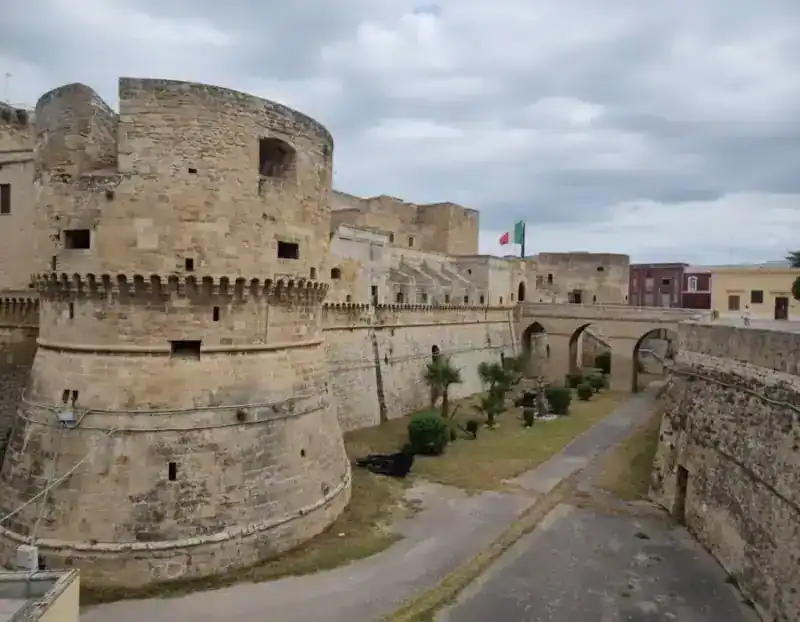
The Castello Svevo rises from the heart of Brindisi like a stone sentinel, its massive walls still guarding the city's inner harbor just as they did in the 13th century. Built by Frederick II of Swabia, this fortress was never just a castle it was a strategic anchor in the Adriatic, watching over crusader fleets, merchant convoys, and rival navies. Today it stands as one of the most powerful reminders of Puglia's medieval military architecture, inviting visitors to step back into an era when Brindisi was a gateway between East and West.
Walking the Walls of Empire
The moment you pass through the castle's heavy stone archway, the modern port city fades away. Inside, the massive limestone walls enclose a sequence of courtyards, defensive towers, and vaulted chambers that speak to centuries of strategic evolution. Frederick II's original structure was expanded by the Aragonese in the 15th century, and you can still trace those layers of history in the masonry.
Climb the narrow spiral staircases to the upper terraces and you'll be rewarded with sweeping views over the harbor and the Adriatic beyond. It's easy to imagine sentries scanning the horizon for Ottoman galleys or watching the departure of knights bound for the Holy Land.
- Monumental corner towers with cross-vaulted interiors and arrow slits facing the sea
- Original defensive courtyards where soldiers once drilled and crossbowmen took position
- Panoramic harbor views from the upper ramparts, perfect for understanding Brindisi's strategic importance
- Vaulted stone chambers that once served as armories, prisons, and command rooms
Echoes of Crusades and Commerce
Castello Svevo wasn't just a military outpost it was a crossroads. During the Crusades, Brindisi's port buzzed with knights, pilgrims, and merchants, and this fortress served as a control point and customs hub. Walking through the chambers today, you can almost hear the clatter of armor and the babel of languages that once filled these halls.
The castle's architecture reflects the pragmatism of Swabian design: thick walls, minimal decoration, maximum defense. Yet there's a stark beauty in the geometry of the stone arches and the play of light through the narrow windows. Photographers will find endless compositions in the interplay of shadow and weathered limestone.
Brindisi Beyond the Battlements
After exploring the fortress, take time to wander Brindisi's historic center. The Colonne Romane at the end of Via Appia are just a short walk away, marking the terminus of ancient Rome's most famous road. The waterfront promenade offers cafés where you can sip an aperitivo while watching ferries depart for Greece and Albania.
For a deeper dive into the region's past, pair your castle visit with the nearby Archaeological Museum, which houses artifacts from Messapian, Roman, and medieval Brindisi. If you're craving coastal beauty after your dose of history, the nature reserve of Torre Guaceto is 20 minutes north pristine beaches and crystal shallows that feel a world away from the fortress stones.
Timing Your Visit
The castle is at its most atmospheric in the late afternoon, when golden light warms the limestone and the crowds thin. Spring and autumn bring comfortable temperatures for climbing towers and exploring courtyards without the intense summer heat. If you're visiting in summer, aim for early morning or late afternoon to avoid the midday sun on the exposed ramparts.
Castello Svevo rewards slow exploration. Give yourself at least an hour to wander, climb, and absorb the layers of history embedded in these walls it's a journey through the medieval heart of Puglia's maritime power.