
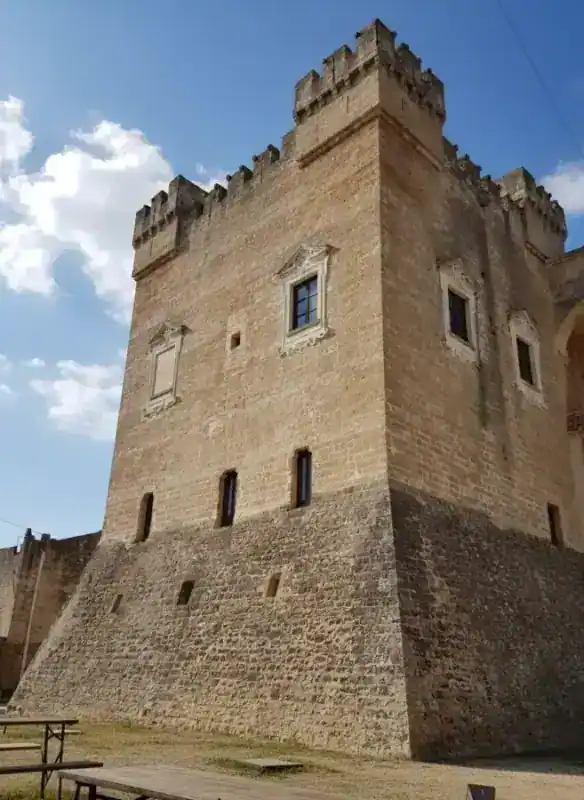
The Castello Normanno-Svevo rises from the heart of Mesagne like a sentinel frozen in time, its honey-colored stone walls echoing centuries of Norman and Swabian rule. Built to guard the inland routes between the Adriatic coast and the fertile plains of Brindisi, this fortress tells a story of strategic might, architectural ambition, and the layered history that defines Puglia's medieval landscape.
Stone Giants and Coastal Vigilance
The castle's massive square towers and thick curtain walls were designed not just to intimidate but to endure. Walking through the central courtyard, you feel the weight of history in every archway and arrow slit. The fortress was a critical node in the defensive network that stretched from Brindisi to Lecce, watching over trade routes and signaling danger from the coast.
From the upper ramparts when accessible the view stretches toward the Adriatic, a reminder that Mesagne's position was never accidental. The Normans knew that controlling the hinterland meant controlling the region.
Layers of Power, Centuries of Change
What makes the Castello Normanno-Svevo so compelling is its architectural palimpsest. The original Norman stronghold was reinforced and reshaped under Swabian rule, then adapted again through the centuries. You can trace these changes in the stonework: the compact, defensive lines of the Normans give way to the more elaborate forms of later medieval builders.
- Massive corner towers that anchored the fortress against siege and assault
- Well-preserved stone vaults in the interior halls, cool even in summer
- Defensive arrow slits positioned to cover every approach
- Strategic sightlines that once linked this castle to others along the coast
- Gothic and Norman details blended in doorways and capitals
Beyond the Fortress Walls
Mesagne itself rewards a slow afternoon of exploration. The centro storico fans out from the castle in a tangle of whitewashed lanes, Baroque churches, and quiet piazzas where locals gather for evening passeggiata. Pair your castle visit with a wander through the historic quarter, where trattorias serve rustic Brindisi-style dishes orecchiette con cime di rapa, grilled lamb, and olive oil pressed from groves that have stood for generations.
If you're drawn to the medieval thread, the nearby town of Oria just fifteen minutes inland offers another dramatic Norman castle and sweeping views over the Murgia plateau. To the east, the Adriatic coast at Torre Santa Sabina and the marine reserve near Torre Guaceto provide a refreshing counterpoint to stone and history, with crystalline water and protected dunes.
When to Visit and What to Bring
The castle is best visited in the cooler months autumn through spring when the stone halls offer shelter from the sun rather than intensifying it. If you come in summer, aim for early morning or late afternoon. Bring sturdy shoes; the stone floors and uneven thresholds demand proper footing. A camera is essential: the play of light on the golden stone shifts throughout the day, and the courtyard's geometry rewards patient composition.
The fortress feels most alive when you let your imagination populate the empty halls picture soldiers on the ramparts, messengers arriving with news from the coast, the clang of iron and the crackle of torches. This is a place where history isn't behind glass; it's underfoot, overhead, and all around you.