
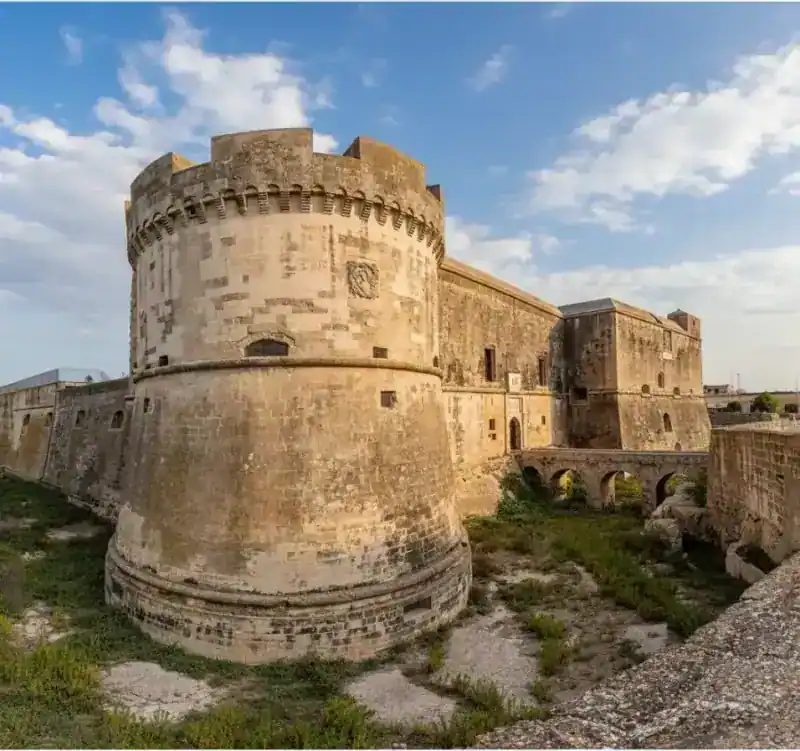
The Castello di Acaya rises from the heart of a tiny walled village in the Province of Lecce, a testament to Renaissance military genius frozen in honey-colored stone. Built in the 16th century as a strategic defensive bulwark, the fortress still radiates the austere elegance of its epoch, its geometric layout and defensive walls whispering tales of a time when watchtowers scanned the horizon for Ottoman sails. Stepping through its ancient gates feels like crossing a threshold into a world where architecture and warfare danced together in perfect, calculated symmetry.
A Masterpiece of Military Geometry
What sets this castle apart is its remarkably intact geometric design, a hallmark of Renaissance military architecture. Unlike the chaotic medieval fortresses that evolved over centuries, Acaya was conceived as a unified vision angular bastions, thick ramparts, and arrow-straight sightlines all working in concert. Walking along the perimeter, you'll notice how every corner was engineered for overlapping fields of fire, a chessboard of stone designed to repel invaders.
The fortress walls are thick enough to absorb cannon fire, yet the proportions remain strangely graceful. On a quiet morning, when the light slants across the battlements, the interplay of shadow and stone feels almost sculptural.
Stories Carved in Stone
The castle's history is woven into the very fabric of Acaya, one of the few borghi in Puglia that retains its original Renaissance street plan. The lord Alfonso Acaya commissioned this fortress not just as a military installation but as a statement of power and prestige. Today, the village still huddles within the defensive circuit, its quiet lanes lined with low whitewashed houses that seem to lean inward, as if still seeking the castle's protection.
Wander through the village before or after your castle visit the synergy between fortress and borgo is rare and deeply atmospheric. Local residents take pride in their heritage, and you might catch a glimpse of artisan workshops or tiny family-run trattorie tucked into centuries-old stone.
What to Look For During Your Visit
As you explore, keep an eye out for these highlights that bring the fortress to life:
- The angular bastions at each corner, designed to eliminate blind spots and maximize defensive coverage
- Original stone carvings and heraldic crests embedded in the walls, marking the legacy of the Acaya family
- The panoramic views from the ramparts, offering sweeping vistas over the surrounding olive groves and the rooftops of the village
- The vaulted interiors, cool and echoing, where soldiers once stored gunpowder and provisions
- The interplay of light and shadow in the inner courtyard, especially dramatic in late afternoon
Pairing Your Castle Visit with the Surrounding Area
Acaya sits just a few kilometers inland from the Adriatic coast, making it an ideal stop between beach days and cultural exploration. The nearby town of Vernole offers a taste of everyday Puglian life, while the baroque splendor of Lecce is a short drive southwest. If you're drawn to coastal beauty, the crystalline waters of Torre dell'Orso and the sea caves of Roca Vecchia are both within easy reach.
The castle is especially magical during the golden hour, when the stone glows amber and the shadows grow long. Bring a camera, wear comfortable shoes for the uneven cobblestones, and allow time to simply sit and absorb the atmosphere this is a place that rewards slow, contemplative exploration.