
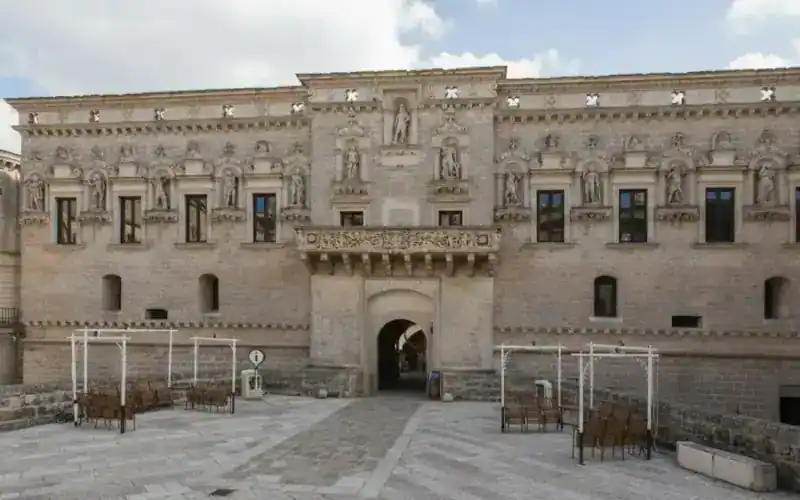
In the quiet heart of Corigliano d'Otranto, a town nestled between the Adriatic coast and the ancient olive groves of Puglia, Castello de' Monti rises as a testament to the region's layered medieval past. This fortress has stood witness to Byzantine rule, Norman conquests, and the slow passage of centuries, its stone walls holding the memory of a landscape that has always been a crossroads of cultures.
Stone Sentinels and Architectural Echoes
Walking through the castle's entrance, you're immediately struck by the massive stone blocks that form the foundation each one carefully quarried and placed by hands that worked centuries ago. The walls aren't perfectly smooth or symmetrical; they bear the irregular beauty of medieval craftsmanship, where function and defense shaped every angle.
The fortress layout reveals the strategic mind of its builders, with thick defensive walls designed to withstand sieges and arrow slits that frame unexpected views of the surrounding town. Light filters through these narrow openings, casting dramatic shadows that shift throughout the day.
Layers of History Beneath Your Feet
The castle's stones tell multiple stories Byzantine foundations, Norman modifications, later Renaissance touches. As you explore, you'll notice how different construction techniques mark different eras, a kind of architectural palimpsest where each generation left its mark.
The interior spaces, though worn by time, still convey the scale and ambition of medieval fortification. Vaulted ceilings, worn staircases, and remnants of frescoes hint at the daily life that once animated these halls soldiers on watch, nobles in residence, the constant hum of a functioning stronghold.
What to Notice During Your Visit
- The entrance portal look for carved details that survived centuries of weathering
- Views from the upper levels across Corigliano d'Otranto's rooftops toward the distant coast
- The contrast between rough defensive walls and more refined interior stonework
- Original arrow slits and defensive features that reveal medieval military architecture
- Stone inscriptions and heraldic symbols that mark different noble families who held the castle
The Castle in Context
Castello de' Monti sits in a town that still preserves its Griko linguistic heritage a Greek dialect spoken here for over a millennium. The fortress was part of a network of defensive structures protecting the terra between Otranto and Lecce, a landscape of strategic importance throughout the Middle Ages.
After exploring the castle, wander Corigliano d'Otranto's compact historic center, where whitewashed houses cluster along narrow streets. The nearby masserie and countryside churches make excellent additions to your visit, and the Adriatic coast is less than fifteen minutes away by car, offering a perfect contrast of medieval stone and turquoise water.