
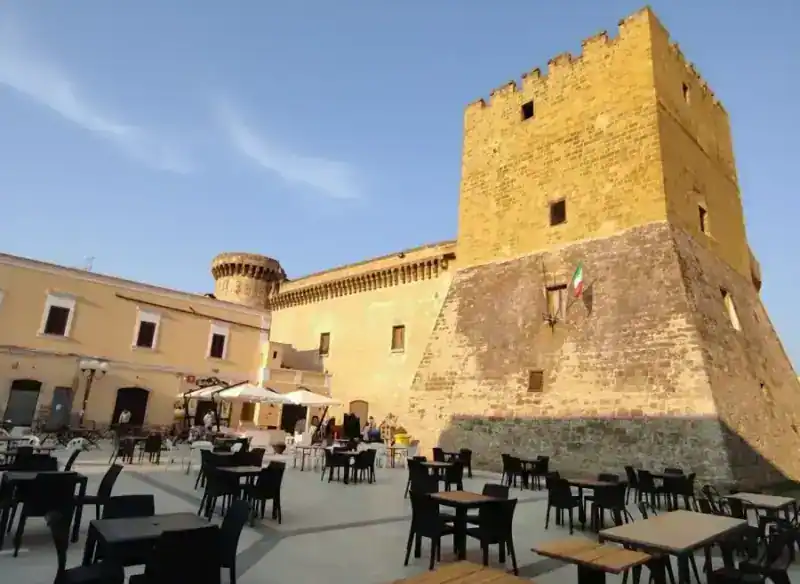
In the compact historic center of Pulsano, on the Ionian coast of Puglia, Castello De Falconibus rises like a sentinel from another century. This medieval fortress wears its age with pride stone towers punctuate the skyline, weathered defensive walls tell stories of bygone eras, and every corner invites visitors to imagine the lives of those who once walked these ramparts. It's not a meticulously restored palace; it's an authentic relic of feudal Puglia, where history and everyday life still intertwine.
Towers That Touch the Sky
The castle's stone towers are its defining feature, commanding attention from every angle. Climbing up (where accessible) rewards you with panoramic views over the surrounding countryside a patchwork of olive groves, low-lying vineyards, and terracotta rooftops stretching toward the glittering Ionian Sea. On clear days, you can trace the coastline all the way to the distant haze where land meets water.
The towers themselves are study subjects in medieval military architecture. Notice the arrow slits, the thickness of the walls designed to withstand siege, and the clever positioning that allowed defenders to survey approaching roads. Even if you're not a history buff, the sheer scale and craftsmanship leave an impression.
Walking the Walls of Time
The defensive walls encircle the castle like a stone embrace, and wandering along them (or around their perimeter) is one of the most atmospheric experiences in Pulsano. The stonework is rough, unpolished, and real this isn't a theme park reconstruction but a living monument that has weathered centuries of sun, wind, and rain.
Look for the weathered coats of arms and inscriptions carved into the stone. These traces of the De Falconibus family and successive owners add layers of narrative to your visit. The castle has seen Norman lords, Angevin rulers, and local nobility; each left their mark, literally and figuratively.
Beyond the Battlements
Pulsano itself is a charming, often-overlooked town that rewards slow exploration. After visiting the castle, wander the narrow streets of the centro storico, where whitewashed houses lean close and local nonne still sit outside their doors in the late afternoon. The town's location perched between the hills and the Ionian coast makes it an ideal base for combining cultural visits with beach time.
- Marina di Pulsano, just a few kilometers away, offers clean sandy beaches and family-friendly lidos
- The nearby town of Leporano has ancient archaeological sites and coastal trails
- In late summer, Pulsano hosts evening festivals in the castle's shadow, with live music and street food
- Visit in the early morning or late afternoon to avoid midday heat and enjoy the best light for photography
- Combine your castle visit with a drive through the Murge Tarantine, the rolling hills dotted with trulli and masserie
A Fortress for Daydreamers
What makes Castello De Falconibus special isn't just its architecture it's the sense of quiet discovery. You won't find crowds or souvenir stands here; instead, you'll find locals going about their day, elderly gentlemen playing cards in the piazza, and a castle that feels less like a museum and more like a natural part of the town's fabric. It's history you can touch, air you can breathe, and a view you won't soon forget.
Whether you're tracing the footsteps of medieval knights or simply seeking a peaceful corner of Puglia that hasn't been overrun by tourism, this fortress in Pulsano delivers an experience that feels genuine, unfiltered, and surprisingly moving.