
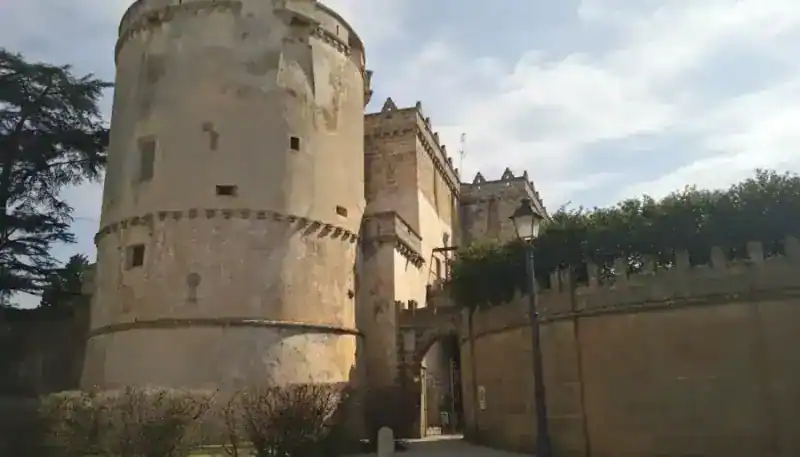
In the heart of Morciano di Leuca, a town that marks the transition between the Adriatic and Ionian coasts of Puglia, stands the imposing Castello Castromediano-Valentini. This fortified structure blends medieval defensive power with the elegance of Renaissance additions, offering a tangible journey through centuries of noble life and strategic importance. The castle dominates Piazza San Giovanni, its stone walls and corner towers a reminder of an era when fortifications were essential to survival.
Layers of Stone and History
The castle's architecture tells a story of evolution. What began as a medieval fortress gradually transformed as successive owners added Renaissance courtyards, elegant loggias, and decorative stonework. Walking through the complex, you'll notice the contrast between the austere, defensive lower levels and the more refined upper floors where noble families once lived.
The corner towers and thick perimeter walls speak to the castle's original military function, while the interior spaces reveal a shift toward residential comfort and aesthetic refinement. It's a layered narrative in stone, where each century left its mark.
What You'll Experience Inside
Though the castle is not always fully accessible, when open it offers glimpses into its historical depth. The courtyards provide a sense of the daily rhythms of castle life, while the preserved architectural details arched doorways, vaulted ceilings, carved keystones reward close attention.
- Defensive features including watchtowers and strategic vantage points over the surrounding countryside
- Renaissance courtyards with traces of elegant stonework and period architectural details
- Thick perimeter walls that once protected the town's noble families and their retainers
- Views from the upper levels across Morciano's historic center and the nearby campagna
- Stone carvings and heraldic symbols reflecting the Castromediano and Valentini lineages
Woven into the Fabric of Morciano
The castle isn't isolated it's woven into the living fabric of Morciano di Leuca. The piazza around it hums with local life: cafés, small shops, residents going about their day. Visiting the castle means also experiencing the town itself, a place where Baroque churches, whitewashed lanes, and family-run trattorias create an authentic southern Puglian atmosphere.
Morciano is just a short drive from the dramatic coastline where the two seas meet, making the castle an ideal cultural stop before or after exploring beaches like Torre Vado or the windswept cliffs near Leuca. Pair your visit with a walk through the town's old quarter, where you'll find quiet corners and local artisans still practicing traditional crafts.
Timing Your Visit
The castle is best experienced in the cooler months or early morning in summer, when the stone courtyards and shaded passages offer relief from the Puglian sun. Check locally for any special openings or cultural events occasionally the castle hosts exhibitions or historical reenactments that bring its past vividly to life.
Photography enthusiasts will appreciate the play of light on the weathered stone, especially in the golden hours. The surrounding piazza and narrow streets provide endless compositional opportunities, capturing the castle in its lived-in, timeless context.