
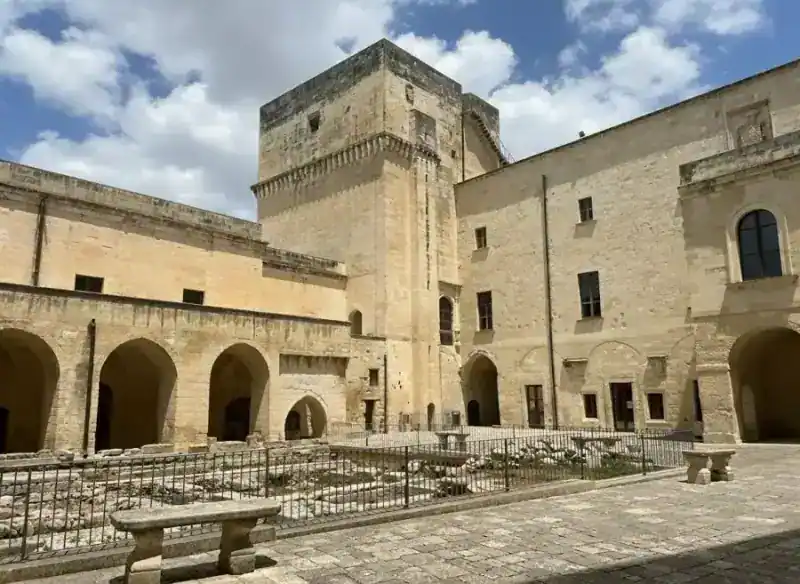
In the heart of Lecce, just steps from the city's famous Baroque piazzas, Castello Carlo V stands as a powerful reminder of a different era when thick walls and star-shaped bastions meant the difference between survival and conquest. Built in the mid-16th century under the Spanish Holy Roman Emperor Charles V, this fortress was designed to defend against Ottoman raids and rival European powers, and its angular geometry still commands attention today.
A Fortress Built for Strategy, Not Show
Unlike the exuberant churches and palazzi that define Lecce's centro storico, the castle is all about function. Its trapezoidal layout and projecting bastions were cutting-edge military architecture in the Renaissance, allowing defenders to cover every angle with cannon fire. Walking the perimeter, you'll notice how the walls taper inward a design meant to deflect projectiles and absorb the shock of bombardment.
The moat that once encircled the structure is now a tree-lined promenade, and the interior courtyards host exhibitions and cultural events year-round. The contrast between martial efficiency and the ornate Baroque streetscape just beyond the ramparts is one of Lecce's most striking juxtapositions.
What You'll Discover Inside
The castle's interior is surprisingly open and light-filled, with vaulted halls and stone staircases that invite exploration. Permanent and rotating exhibitions dive into local archaeology, medieval history, and contemporary art, so every visit can reveal something new.
- Walk the ramparts for rooftop views over Lecce's honey-colored domes and bell towers
- Explore the sala ipogea, an underground chamber that once stored gunpowder and supplies
- Admire the carved Habsburg coat of arms above the main gate a relic of Spanish rule
- Check the exhibition calendar; the castle regularly hosts photo shows, concerts, and craft markets
- Combine your visit with a stroll through nearby Piazza Sant'Oronzo and the Roman amphitheater
When to Go and What to Pair It With
Morning light is kindest for photography, and weekday visits tend to be quieter. Because entry is free, the castle makes an excellent anchor for a full day of exploring Lecce's pedestrian core pair it with a coffee at a café in Piazza del Duomo, then wander the boutiques along Via Palmieri.
If you're visiting in summer, late afternoon offers cooler temperatures and the chance to catch golden-hour light on the stone walls. The castle sits at the edge of the old town, so it's an easy starting or ending point for any walking itinerary through Lecce's labyrinth of Baroque marvels.