
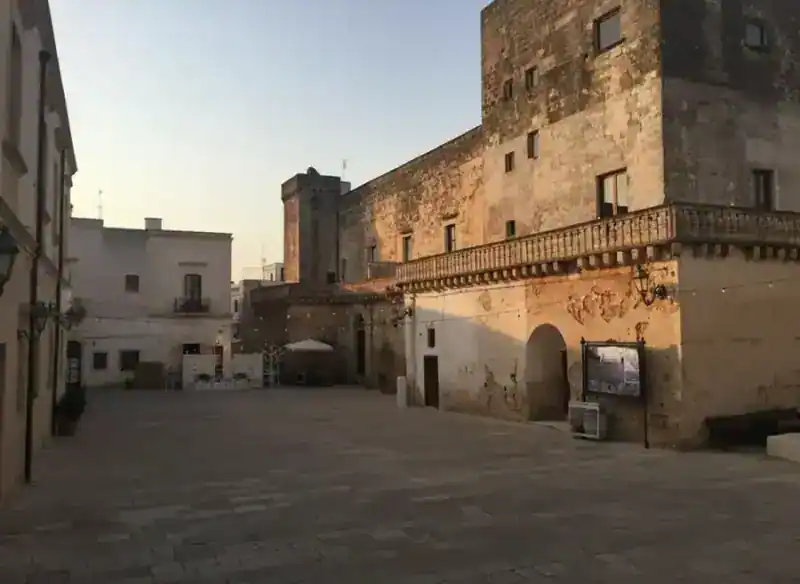
In the heart of Felline, a quiet frazione in the province of Lecce, the Castello Baronale rises like a sentinel from another age. Its thick stone walls and defensive towers speak of a time when watchtowers scanned the horizon for raiders, and noble families ruled vast estates across the Puglian countryside. This is not a polished museum piece it's a lived-in monument, a place where history and daily life still intertwine.
Stone Walls That Tell Stories
The castle's architecture is pure medieval pragmatism: massive limestone blocks, narrow arrow slits, and corners designed to repel invaders. Walk along the perimeter and you'll notice the subtle asymmetry centuries of repairs, additions, and adaptations layered like archaeological strata. The fortress evolved from Norman origins through Aragonese and Baroque periods, each leaving its mark in the masonry.
Local lore says the castle was a key link in the region's defensive network, communicating by signal fire with coastal towers along the Ionian and Adriatic coasts. On clear days, you can almost imagine the view from the battlements stretching toward Gallipoli to the west and the Serra hills to the east.
A Window Into Feudal Puglia
Felline itself was a feudal holding, and the castle was the seat of power for a succession of baronial families. The interior courtyard often accessible during daylight hours gives a tangible sense of that hierarchy. Nobles entertained in the upper loggia; servants and soldiers moved through the lower arcades. The worn stone steps have been climbed by centuries of boots, sandals, and bare feet.
Today, the castle anchors a sleepy village where old women still sit on doorsteps in the late afternoon and children play soccer in the piazza. It's a rare chance to see a monument not cordoned off from daily life but woven into it.
What to Look For and When to Visit
Arrive in the late afternoon, when the golden light rakes across the façade and the stone glows amber. Bring a camera the contrasts of shadow and texture are spectacular. The castle is especially atmospheric during the cooler months, when mist rolls in from the surrounding olive groves and the fortress takes on an almost ghostly presence.
- Arrow slits and battlements: Check the upper walls for original defensive features still intact.
- Courtyard arcades: Look for Baroque-era additions grafted onto medieval foundations.
- Village context: Wander the narrow streets around the castle Felline's layout hasn't changed much since the 1600s.
- Nearby olive mills: The area is dotted with historic frantoi (oil mills), some now converted to agriturismi.
- Combine with Alliste: Just 3 km away, the larger town of Alliste offers trattorias and a lively weekly market.
Beyond the Fortress Walls
Felline sits in the fertile plains between the Serra Salentina hills and the Ionian coast, an area known for olive oil and wine production. After visiting the castle, drive 10 minutes west to reach the beaches of Racale and Torre Suda, or head inland to explore the baroque splendor of Casarano. The contrast between the rugged medieval fortress and the ornate churches of nearby towns highlights the rich layers of Puglian history.
This is a place for slow exploration no crowds, no ticket queues, just you and the stones. It rewards the kind of traveler who enjoys stumbling upon history in its natural setting, where the past is still part of the present.