
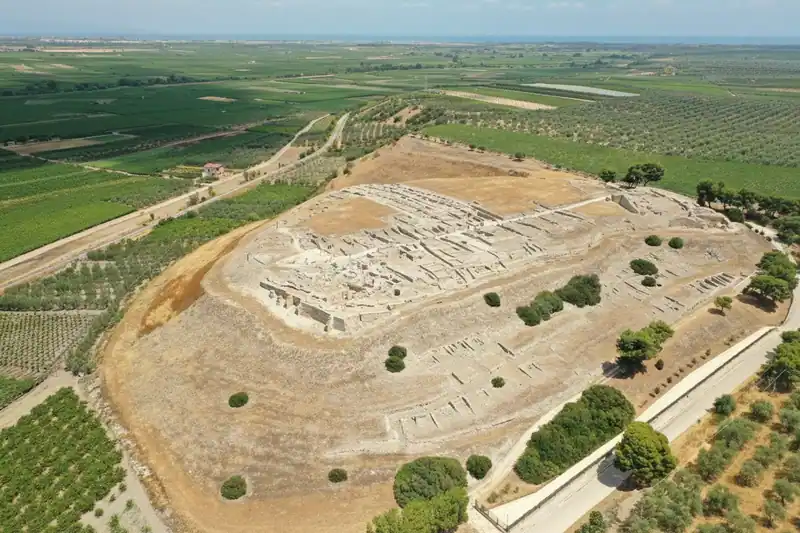
On a windswept plateau just outside Barletta, the Archaeological Park of Canne della Battaglia preserves one of ancient history's most dramatic turning points. Here in 216 BCE, Hannibal's Carthaginian army crushed a Roman force nearly twice its size, a battle so catastrophic that its tactics are still studied in military academies today. The landscape itself becomes your guide, with stone foundations, defensive walls, and the outline of streets tracing a settlement that witnessed empires rise and fall.
Walking the Ground of Legend
The site sprawls across the plain where the Ofanto River once shaped the contours of combat. You'll find yourself tracing the edges of ancient dwellings, their stone footprints barely rising above the grass, while interpretive panels reconstruct the choreography of battle. The silence here is profound, broken only by the wind and the occasional rustle of wild herbs that now reclaim the field.
The Antiquarium on site houses artifacts unearthed from the battlefield fragments of armor, pottery, and tools that ground the grand historical narrative in tactile, human scale. It's a small museum, intimate enough to focus your attention without overwhelming, and it complements the outdoor experience perfectly.
Layers of Settlement and Strategy
Canne wasn't only a battlefield; it was a thriving settlement from the Bronze Age through the medieval period. As you wander the ruins, you'll notice stratified foundations revealing centuries of occupation, from ancient Daunian huts to Roman-era structures and later Byzantine fortifications. Each layer tells a story of adaptation, commerce, and survival in a landscape that was always strategically vital.
- Bronze Age traces beneath Roman walls reveal millennia of human presence
- Medieval watchtower ruins perch on the hilltop, offering sweeping views toward the Adriatic
- Pottery shards and olive presses scattered throughout hint at daily life beyond warfare
- Defensive ramparts curve around the settlement's perimeter, their engineering still visible
The View That Frames History
Climb to the highest point of the site, near the remains of the medieval tower, and the tactical genius of Hannibal's double-envelopment maneuver becomes suddenly, viscerally clear. The plain stretches out below, the river's course marked by a ribbon of green, and you can almost see the tightening noose of Carthaginian cavalry. It's a landscape that rewards slow observation bring water, wear sturdy shoes, and give yourself at least ninety minutes to absorb it all.
The park sits just off the SP142, roughly ten kilometers from central Barletta, making it an ideal half-day excursion paired with a visit to Barletta's imposing Castello Svevo or the Colossus statue on the seafront. Spring and autumn are the best seasons; summer sun can be relentless on the exposed plateau, though the late-afternoon light bathes the ruins in gold worth photographing.
Archaeology You Can Touch
Unlike many archaeological sites roped off and distant, Canne invites you to walk among the stones, to sit on the edge of an ancient threshold and imagine the footsteps that wore it smooth. The lack of crowds this is not a mass-tourism destination gives the place an atmosphere of contemplation rare in Italy's better-known ruins. Families with curious children, history buffs, and anyone seeking a quieter, more introspective encounter with the past will find Canne deeply rewarding.