
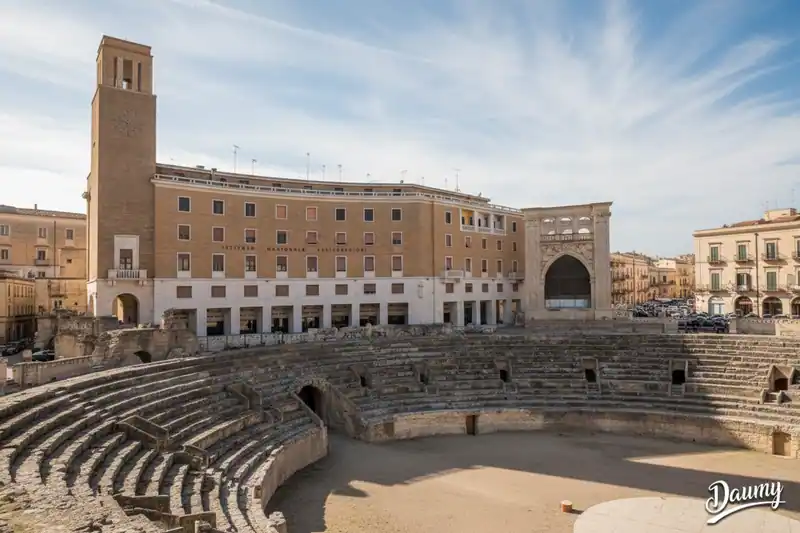
In the heart of Lecce, beneath the bustling café tables and market stalls of Piazza Sant'Oronzo, a monumental oval of stone emerges from two millennia past. The Anfiteatro Romano wasn't discovered until the early 20th century, its carved seats and corridors hidden under centuries of medieval and baroque construction. Today, half the amphitheater remains buried beneath the square, but what you can see tiers of honey-colored limestone, arched passageways, and the ghostly outlines of seating rows offers a visceral connection to the entertainments and public gatherings that once defined Roman Lecce.
When the Piazza Was an Arena
Imagine this square filled with 25,000 spectators, their voices echoing off stone as gladiators clashed below. The amphitheater dates to the 2nd century AD, during the reign of Emperor Trajan, when Lecce then known as Lupiae was a thriving Roman municipium. The structure was designed not only for combat but for venationes (wild animal hunts), theatrical performances, and civic ceremonies that reinforced imperial power and local identity.
Walking along the exposed rim today, you'll notice the precision of Roman engineering: the curvature of each tier, the channels for crowd flow, the remnants of the cavea (seating area). Early morning light is especially dramatic, casting long shadows across the carved stone and illuminating details worn smooth by centuries.
Half Hidden, Fully Fascinating
One of the amphitheater's most intriguing qualities is its partial visibility. Much of the northern half lies beneath Piazza Sant'Oronzo's pavement, preserved but inaccessible. This creates a unique layering effect: you stand in a baroque square, surrounded by the column of Sant'Oronzo and the ornate façade of the Sedile, while ancient Rome literally sits at your feet.
- Stone inscriptions and carved details still visible on the exposed seating blocks
- Vaulted passageways that once funneled crowds into the arena
- Fragments of decorative friezes hinting at the amphitheater's original grandeur
- Views from the square's edge down into the excavated sections, best in golden-hour light
Exploring the Layers of Lecce
The amphitheater sits at the crossroads of Lecce's historic center, making it an ideal anchor for a walking route. Just steps away, the baroque extravagance of Basilica di Santa Croce and Piazza del Duomo contrasts strikingly with the amphitheater's austere Roman lines. To the south, the narrow streets of the old Jewish quarter reveal workshops where cartapesta (papier-mâché) artisans still practice centuries-old crafts.
For a deeper dive into Roman Lecce, pair your visit with the nearby Teatro Romano on Via dell'Arte della Cartapesta, another excavated treasure that hosted dramatic performances. Together, these sites paint a portrait of a city where every era Roman, medieval, baroque remains legible in stone, waiting for you to read its story.